

Gleneagles Hospital, TIS-H brings hospitals, technology leaders together to shape responsible Healthcare AI
As healthcare AI enters hospitals, clinicians stress the need for evidence, safety, privacy, and real-world performance

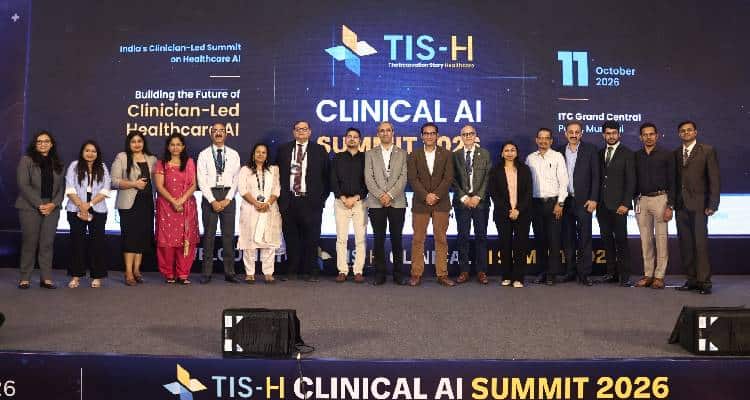

As healthcare AI moves rapidly from innovation to real-world implementation, the TIS-H Clinical AI Summit 2026 brought together clinicians, hospital leaders, healthcare AI companies, researchers, innovators, and industry stakeholders to explore how to make emerging technologies safe, validated, and meaningful for patient care. Organised by TIS-H, the healthcare vertical of The Innovation Story, with Gleneagles Hospital Mumbai as the Hospital and Pre-Summit Workshop Venue Partner, the summit was held at ITC Grand Central, Parel, Mumbai, and focused on practical pathways to move promising AI solutions beyond pilots and towards responsible clinical deployment.
Experts call for safe and validated healthcare AI
The summit, themed ‘Building the Future of Clinician-Led Healthcare AI’, placed clinicians at the centre of conversations around AI adoption. Discussions focused on how AI can be assessed for clinical relevance, safety, evidence, workflow integration, patient-data protection and accountability before being introduced into routine care.
The event brought together stakeholders from across the healthcare AI ecosystem, including clinicians, hospital leaders, healthcare AI startups, researchers, technology companies and governance and policy experts. The Startup Deployment Forum examined the journey from product development to hospital readiness, while the Innovation Roundtable explored how promising pilots can progress towards validated and scalable deployments. Discussions also covered AI applications across radiology, pathology, critical care, perioperative care and hospital workflows.
Meenal Majumder, Founder & CEO, The Innovation Story said, “Healthcare innovation cannot stop at creating a promising technology; it has to find a pathway into real-world care. AI solutions may demonstrate strong potential during development or pilot programmes, but hospitals and clinicians need to assess whether they address genuine clinical needs and can work safely within actual healthcare environments. TIS-H was created to bring these different stakeholders into the same conversation, so that promising technologies can move through the right stages of validation, adoption and implementation. The focus is not simply on what AI can do, but on identifying where it can genuinely add value to patient care and how it can be introduced responsibly.”
Before AI reaches patients, clinical validation Is key
A key focus of the summit was the need to assess AI solutions in real clinical settings before they are introduced into routine care. Experts highlighted the importance of evaluating accuracy, safety, usability and performance across different patient situations, rather than relying only on results from controlled development or pilot environments.
Dr Meera Santosh, Convenor, TIS-H Clinical AI Summit 2026 and Consultant Anesthesiologist, Gleneagles Hospital Mumbai, said, “Clinical validation has to be an important step before any AI solution moves into patient care. A technology may appear promising from a technical perspective, but doctors need to understand how accurately it performs in real clinical situations, where patients can present with very different conditions and decisions may be time-sensitive. We need to look at whether the technology is safe, whether its performance is consistent, and whether it fits into existing clinical workflows without creating additional risks. Most importantly, we have to ask whether it genuinely helps the patient. Clinicians therefore need to be involved early in evaluating AI, so that safety, clinical relevance and patient outcomes remain central to the process.”
Moving from validation to responsible deployment
The summit also examined what happens after an AI solution has shown clinical promise. TIS-H outlined a four-stage approach that is Validate, Deploy, Govern and Scale – covering the key considerations involved in moving healthcare AI from an idea to wider implementation. Validate focuses on clinical evidence, safety, bias and real-world performance. Deploy addresses workflow integration, interoperability and implementation readiness. Govern covers privacy, accountability, explainability, ethics and regulation, while Scale looks at efficiency, system-wide impact and sustainable value.
Dr Bipin Chevale, CEO, Gleneagles Hospital Mumbai said, “Every technological leap in healthcare must ultimately safeguard patient care. AI has enormous potential to support clinicians and strengthen healthcare delivery, but responsible adoption has to remain at the foundation of this journey. Hospitals work with highly sensitive patient information and make decisions that can have consequences, so privacy, accountability, explainability, ethics and regulation cannot be treated as separate issues. Before an AI solution becomes part of patient care, it needs to demonstrate that it is clinically relevant, appropriately validated and capable of working safely within the hospital environment. Bringing clinicians, hospitals and technology innovators together is an important part of building this trust.”
The summit highlighted that the next phase of healthcare AI will depend not only on technological capability, but on evidence, clinical validation, safety, privacy, workflow integration and patient trust.
- Advertisement -