

Chhattisgarh community-based nutrition programme screens 2.65 lakh children
In Chhattisgarh, government statistics put the proportion of children who are underdeveloped at 27.5 per cent, those who are weak at 21.1 per cent and those who are severely weak at 6.7 per cent.

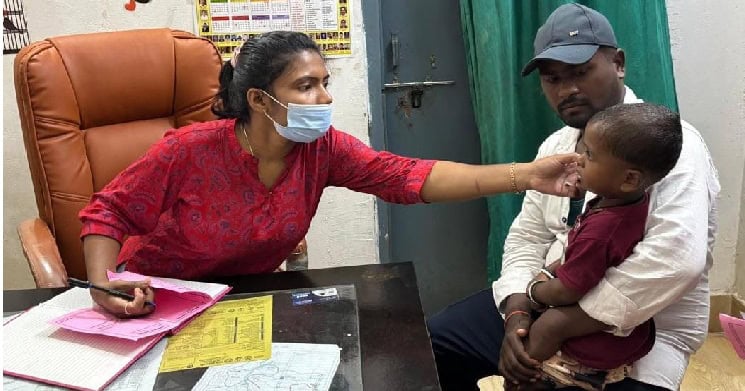

Chhattisgarh’s Hamar Swasth Laika programme, which expanded to cover the entire state in September 2024, has covered 1.21 lakh children by March 2025, with the cumulative number reaching 2.65 lakh so far. Under the scheme, children are routinely screened for growth and nutritional status at anganwadi centres across the state.
As per a press release, 0f the children treated, 59,043 were severely malnourished and 2,06,544 moderately malnourished. 65 per cent of the former and 70 per cent of the latter have shown health improvements. Over 52,000 anganwadi workers across 146 development blocks have played a key role in the programme to combat malnutrition among children.
Commenting on the scheme’s impact, Chief Minister Vishnu Deo Sai said, “Hamar Swasth Laika Abhiyan is delivering positive results in improving the nutritional status of children. Our goal is to ensure that every child in Chhattisgarh is healthy, well-nourished and has the opportunity to build a brighter future.”
As per the Women and Child Development Department, 85 to 90 per cent of severely and moderately acute malnourished children have no medical complications and can be managed in their own communities, while those with complications are treated at Nutrition Rehabilitation Centres.
Treatment begins at the anganwadi centre, where monthly growth monitoring identified children with severe or moderate malnourishment. An appetite test and a medical examination helps the Health Department decide the next course of action. Each child receives a fortified take-home ration, along with essential medicines and the family is given counselling. Healthy children are discharged after 16 weeks of weekly follow-up and monthly monitoring continues for a further six months.
The fortified dry food supplies 456 kilocalories and 16.7 grams of protein per 100 grams and is prepared as laddoo, kheer, halwa or roti. The pilot projects in Mohla-Manpur-Ambagarh Chowki and Rajnandgaon recorded 77 per cent improvement in nutrition and growth in children.
A parent’s card records the child’s weight, medicines and take-home ration while a diet calendar encourages dietary diversity. The Hamar Swasth Laika (Samarthya) app works in offline mode, tracks children in real time, prompts follow-up automatically and plots growth charts, while dashboards at the district, project and sector levels allow supervisors to review progress. The Health Department, AIIMS Raipur and UNICEF support the Women and Child Development Department in implementing the programme.
The department’s own statistics highlight the urgency of the programme. According to the department, 69 per cent of deaths among children under five in India are linked to nutrition-related problems. Malnutrition weakens a child’s immunity, learning ability and physical development while worsening the severity of illness. A severely or moderately malnourished child who is not managed in time is 11 times more likely to die than a normal child.
In Chhattisgarh, the department puts the proportion of children who are underdeveloped at 27.5 per cent, those who are weak at 21.1 per cent and those who are severely weak at 6.7 per cent. Hamar Swasth Laika represents Chhattisgarh’s effort to take malnutrition care beyond hospitals and closer to communities.
However, the programme’s success will depend on sustaining the gains and continued engagement to prevent children from slipping back into malnutrition.
- Advertisement -