


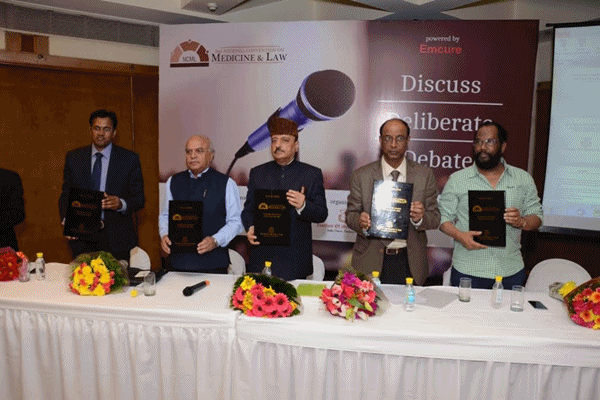

IML releases white paper based on fraternity recommendations to address legal issues in healthcare
The 2nd National Convention on Medicine & Law – 2016 was recently organised by the Institute of Medicine & Law (IML) in New Delhi. A white paper recommending legal reforms in healthcare was released, which will be submitted to policy makers and regulators.
The white paper exhaustively discusses and highlights several medico – legal issues including the need for a new law recognising declaration or certification of Brain Stem Death as a form of death under Uniform Determination of Death Act, a law to enable doctors to refuse treatment or admission in case of ‘futility of care’, to legally recognise Living Wills/ Advance Directives/ DNR Instructions among others.
“India is witnessing a sharp rise in cases of medical negligence in courts along with cases of violence against doctors and hospitals. These indicate a systemic failure and breakdown of trust between doctors and patients. A soft regulatory framework, unrealistically high expectations of patients, and the peculiar socio – economic character of the nation further compound the issue. This does not augur well for a developing country like India and the convention hopes to bring apprise Policy makers and regulators about these contentious issues and recommend changes required in the legal and regulatory framework,” said Advocate Mahendrakumar Bajpai, who was the keynote speaker at the convention.
Dr Ravindra Pandula, Member of Parliament, Amalapuram, Andhra Pradesh, Dr VP Mishra, Chairman – Academic Council, MCI, Dr BC Gupta, Member, National Consumer Disputes Redressal Commission, Dr BD Athani, Special Director General of Health Services, MoHFW were the Guests of Honour at the convention.
“It is inappropriate that courts are forced to find solutions to issues that should have been provided either by the policy makers or the medical fraternity. It is imperative for doctors, medical associations, and hospitals to come together to identify and discuss the legal issues relating to medicine and to find practical and legally appropriate solutions. The recommendations on transplant, HIV, dermatology, intensivists, private hospitals, public hospitals and emergency medicine are generally unanimous in their respective consensus and have been constructively conveyed through the paper,” added Bajpai.
The convention also discussed and addressed several other pressing medico-legal matters that are either still ambiguous or have not received the deserved attention. Some of these include incentivizing organ donation with non – monetary incentives to the donor or family such as giving priority in receiving organs, to allow HIV positive couples to adopt children subject to certain conditions and due diligence performed by the authorities, framing regulations for doctors’ website and its content, and also framing of proper guidelines for tele-consultation and e-consultation among others.
EH News Bureau
- Advertisement -
Comments are closed.