

India sees progress on Encephalitis, experts urge on early recognition
Globally, encephalitis affects three people every minute, yet almost eight in ten people do not know what it is, leading to dangerous delays in diagnosis and treatment.


India has recorded important gains in the prevention and management of encephalitis over the past decade, reflecting stronger clinical care, expanded vaccination coverage and improved surveillance. However, experts caution that progress has been uneven, and delayed recognition and diagnosis continue to result in preventable deaths and long-term neurological disability.
Marking World Encephalitis Day 2026, global non-profit Encephalitis International is calling for renewed focus on early recognition of encephalitis – a potentially fatal inflammation of the brain that can affect anyone and often begins with flu-like symptoms that are often missed.
In 2025, the World Health Organization (WHO) released its first-ever Technical Brief on Encephalitis, recognising the condition as a growing global public health threat and urging countries to strengthen surveillance, vaccination strategies, early diagnosis, treatment and public awareness. The brief helped elevate encephalitis on global and national health agendas, including in India.
India’s experience reflects both progress and emerging challenges.
National data show that mortality among patients with Acute Encephalitis Syndrome (AES) declined from around 12.3% in 2015 to approximately 3.9% in 2022, pointing to improvements in health system response and patient management.
In Uttar Pradesh, one of the states most affected historically, confirmed Japanese Encephalitis (JE) cases declined steadily between 2018 and 2022, largely attributed to strengthened surveillance and government-backed childhood vaccination programmes. However, a shift in JE cases from children to adults, highlights gaps in immunity beyond childhood and ongoing challenges with vaccine uptake.
Recent Indian studies also show that encephalitis is not a single-disease condition. A 2025 prospective study from northern India identified Scrub typhus as the leading cause of Acute Encephalitis Syndrome, with Chikungunya virus emerging as the most common viral cause. As surveillance improves and the definition of AES broadens, other serious infectious causes are increasingly being detected, adding complexity to the encephalitis burden.
This evolving pattern explains why, despite clear gains against “classic” Japanese Encephalitis, encephalitis overall remains a significant public health challenge in India.
“The WHO technical brief helped move encephalitis out of the shadows and onto the global health agenda. In countries like India, we are seeing important improvements in survival, driven by better clinical care and vaccination programmes. But progress is uneven. Too many people still experience severe outcomes simply because encephalitis is not recognised early enough. Awareness remains the missing link – and recognising the warning signs can save lives,” said Dr Ava Easton, Chief Executive of Encephalitis International.
Introducing FLAMES: A simple acronym that can save lives
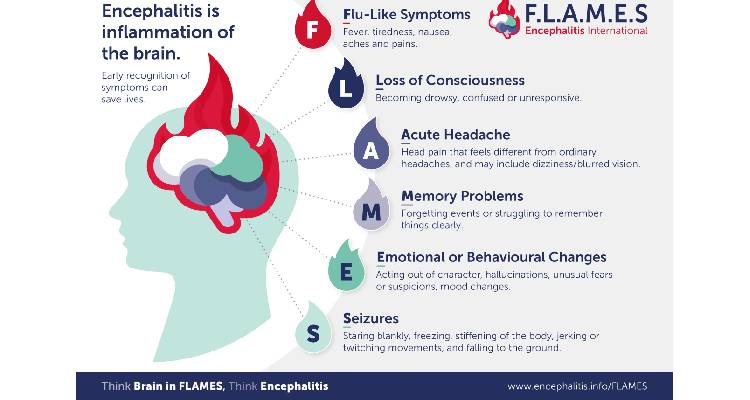
To address the awareness gap, Encephalitis International has launched “Brain In FLAMES”, highlighting the most common warning signs of encephalitis that require urgent medical attention
FLAMES stands for:
F – Flu-like symptoms
L – Loss of consciousness
A – Acute headache
M – Memory problems
E – Emotional or behavioural changes
S – Seizures
The organisation urges the public and non-specialist healthcare providers to seek urgent medical care if these symptoms are present.
Call to action
Encephalitis International leads World Encephalitis Day every year on 22 February and encourages people across India to:
- Learn and share the FLAMES warning signs
- Wear red on the day and share photos or videos using #Red4WED and #WorldEncephalitisDay
- Support global efforts to improve awareness, diagnosis and care for encephalitis through ongoing World Encephalitis Day initiatives
More information on how to get involved, including awareness activities and support opportunities, is available at www.worldencephalitisday.org.
- Advertisement -