

Lack of leadership appears to be biggest public health crisis of our times
Dr. Rajendra Pratap Gupta, Chairman, Health Parliament, talks on leadership, accountability, ahead of the Public Health Transformation Summit 2026 in an interaction with Express Healthcare

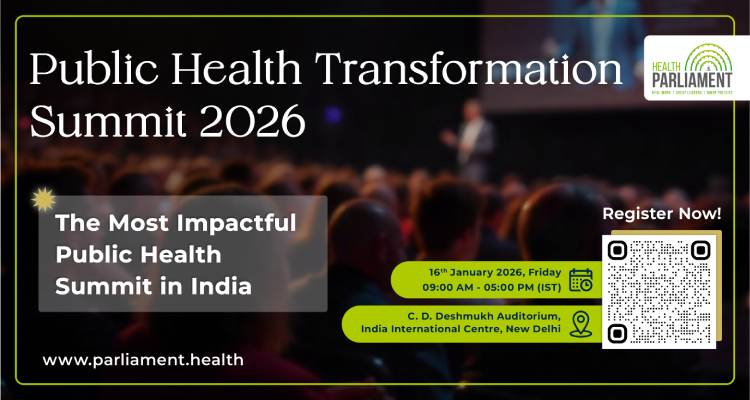

Q: The Public Health Transformation Summit 2026 (PHTS 2026) comes at a time when a discourse in “public health” is needed more than ever before. Why is there a need to create a dedicated platform like PHTS 2026 now?
A: Public health today sits at a paradoxical moment. On the surface, India has a massive opportunity to create a future where an Indian doesn’t just increase longevity but also adds to HALE. But we are currently presiding over an enormous public health challenge, that even drinking water and air are poisonous and takes away precious lives. We need to have a frank discourse for a broken public health system struggling with deep structural fatigue. Hospitals remain overburdened, prevention continues to take a backseat, non-communicable diseases are rising unchecked, and mental health has only recently entered mainstream policy conversations and women health still remains a massive challenge.
Public Health Transformation Summit 2026, organised by Health Parliament, is conceptualised because incremental discussions are no longer enough. India requires a space that looks beyond episodic health crises and asks a harder question: how do we redesign public health for the 21st century? The Summit positions public health not as a sectoral concern, but as national infrastructure – one that intersects policy, industry, technology, environment, and leadership.
Also, while planning for the summit, we realised that we do not a pipeline of leaders for public health, and that to me, lack of leadership appears to be biggest public health crisis of our times. We have to create leaders for the 21st century public health. This summit will work in that direction.
Q: What distinguishes Public Health Transformation Summit 2026 from conventional public health conferences?
A: PHTS 2026 is intentionally designed as a problem-solving forum rather than a ceremonial conference. The emphasis is not on isolated presentations, but on connected conversations with people who matter and the issues that will become insurmountable if we do not address them heads on, now.
Also, like other summits, we do not decide our sessions based on sponsorship and their agenda, we shape the agenda based on the needs of our time, and we dissociate sponsorships with sessions. So, you will find the topics, quality of sessions and discourse and speakers represent a scientific and independent thought process that we need to solve the perennial problems.
Every session is structured to link history, current realities, and future pathways ensuring that dialogue moves from diagnosis to direction.
Another defining feature is who is in the room. PHTS brings policymakers, regulators, industry leaders, public health practitioners, academics, and young professionals into the same space, not as parallel audiences, but as stakeholders in the same system. The Summit challenges silos and creates conditions for sometimes uncomfortable, yet necessary conversations, particularly where responsibility and accountability intersect.
Q: The Summit begins by revisiting the evolution of public health in India. Why look back when the focus is on the future?
A: Because many of today’s challenges are not new, they are unresolved. India’s public health journey includes early innovations such as state-led public health acts, nutrition programmes, supply chain reforms, and grassroots health worker models. Yet, over six decades, while time moved forward, systemic status often did not.
By revisiting this evolution, PHTS 2026 highlights a critical insight: acute problems were never fully solved, chronic diseases accumulated, and pandemics added a new layer of complexity. Understanding this continuity of failure is essential to designing future-ready systems. The Summit’s message is clear – innovation without institutional memory risks repeating the same mistakes in more advanced forms.
Q: A recurring theme at Public Health Transformation Summit is the gap between policy intent and on-ground execution. Where does the system break down?
India today has stronger policy frameworks and clearer political intent than ever before. The challenge now lies in execution. Bureaucratic inertia, limited public health implementation capacity, and weak monitoring and evaluation mechanisms continue to dilute impact.
PHTS 2026 reframes the conversation from “what policies exist” to “who implements them, how, and with what accountability.” The Summit places high emphasis on building public health implementation capacity, professionals who can design locally relevant programmes, execute them effectively, and continuously refine them using data. Without this capacity, even the most progressive policies fail to translate into measurable outcomes.
Also, there are important stakeholders like the pharmaceutical industry, and they have an important role in public health. The summit brings them across the table to re-imagine and discuss their role in the emerging scenario.
Q: One of the most ambitious ideas emerging from Public Health Transformation Summit is the proposal for a Public Health Monitor for India. What does this aim to achieve?
The Public Health Monitor reflects the Summit’s shift from discussion to action. At its core, it recognises a simple truth: solutions require comparative, credible data. The proposed monitor aims to track key public health indicators across all states and union territories, enabling evidence-based decision-making at scale.
Rather than symbolic rankings, the objective is transparency and learning, helping states identify gaps, adopt best practices, and design targeted interventions. If implemented, this initiative could become a foundational tool for policymakers, industry stakeholders, and civil society alike, positioning India as a global reference point in public health measurement. Also, health is a state subject in India, and we must move the needle to states and finally, to districts. This monitor is aimed at measuring and impacting public health
Q: Leadership or the lack of it has emerged as a critical concern. How does Public Health Transformation Summit address this challenge?
India’s demographic reality presents a stark contrast: an average population age of 29, but public health leadership dominated by professionals more than twice that age. This is not a critique of experience, but a warning about continuity.
PHTS 2026 is designed to create a leadership pipeline. By bringing together individuals who have built institutions, designed national missions, and scaled programmes across insurance, digital health, food safety, and regulation, the Summit enables direct exposure for younger professionals. Leadership, as the Summit emphasises, is not learned through textbooks, it emerges through interaction, questioning, and responsibility. PHTS seeks to accelerate that process. The Summit will serve as an annual platform for individuals who aspire to build public health as a career.
Q: The inclusion of a session on “Big Pharma in Public Health” has drawn attention. Why put the pharmaceutical industry under the spotlight?
Because influence demands accountability. Pharmaceutical companies are the most powerful stakeholders in healthcare ecosystems given their financial clout. PHTS 2026 creates a rare space for an honest conversation on the industry’s role beyond commercial success and selling medicines, it is going to speak for a prescription for the pharma industry to play a larger role in helping the health system in becoming more robust.
The session asks direct questions: how much does Big Pharma invest back into public health outcomes? How aligned are corporate strategies with national health priorities? Moderated independently, this discussion is not adversarial but essential. Accountability cannot exist without participation, and leadership requires the willingness to engage with difficult questions.
Q: How has been the response from the governments for this summit?
Overwhelming! We have more than 10 foreign governments represented through their ambassadors, diplomats and top policymakers and regulators from India. Dr. Vinod Paul, Member (Health), NITI Aayog; Shri. Bharat Lal, Secretary General, National Human Rights Commission, India; Mr. Rajit Punhani, Secretary to Government of India & CEO, FSSAI; Dr. Sunil Kumar Barnwal, CEO, National Health Authority amongst others. It is going to be the most engaging summit on public health.
Q: Finally, what should delegates expect to take away from the Public Health Transformation Summit 2026?
Clarity and responsibility. Delegates should leave with a deeper understanding of India’s public health architecture, a realistic perspective on career and leadership pathways, and a sense of ownership over future outcomes.
PHTS 2026 is not positioned as an endpoint, it is the beginning of sustained engagement. The conversations initiated on January 16, 2026, are intended to translate into action in the months that follow. For those who want to shape the future of public health rather than observe it, this Summit is designed to be a defining moment.
The Public Health Transformation Summit 2026 (PHTS 2026) is a flagship, one-day national convening of policymakers, public health leaders, industry stakeholders, academicians, and emerging professionals, focused on reimagining India’s public health system for the next generation. Chaired by Dr. K. Srinath Reddy, President, Public Health Foundation of India (PHFI), the Summit will be held on 16 January 2026 at the India International Centre (IIC), New Delhi, and will serve as a high-level platform for examining structural reforms, leadership pathways, and actionable strategies to strengthen public health delivery in India.
- Advertisement -