

Suneeta Reddy calls for healthcare-led services growth and medical value travel push at AIMA National Management Convention
Speaking at AIMA’s 52nd National Management Convention, Apollo Hospitals’ Suneeta Reddy outlined strategies for services-led growth, healthcare expansion, insurance-backed capacity, integrated wellness, and medical value travel

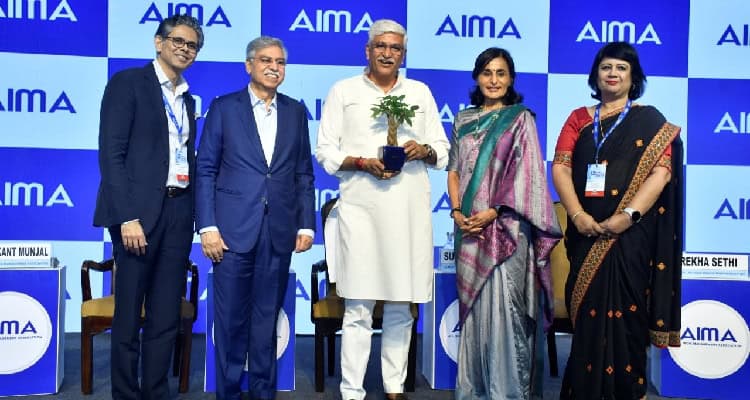

Suneeta Reddy, President of the All India Management Association (AIMA) and Managing Director of Apollo Hospitals Enterprise, presented a services-led growth roadmap with healthcare at its core at the 52nd National Management Convention of AIMA. She also highlighted the potential of medical value travel to generate jobs, foreign exchange and inclusive development.
Reddy was addressing a panel moderated by Sunil Kant Munjal, Past President of AIMA and Chairman of Hero Enterprise, on “Global Trends and Future Strategies: Resilience and Adaptability.” The panel included Vishal Kampani, Vice President of AIMA and Vice Chairman & Managing Director of JM Financial, and Sanjay Kirloskar, Past President of AIMA and Chairman & Managing Director of Kirloskar Brothers.
She underlined the strength of the services sector, noting that it has been expanding at 11–15 per cent annually and already drives India’s exports. “With a demographic dividend unlike any other, this is the time to invest in skilling and job creation in services, especially healthcare. India can be a global exporter of knowledge, people and services,” she said. Referring to India’s external account, she added, “Our $90 billion trade deficit with the US can be offset by exporting services. Medical Value Travel alone is a $100 billion global opportunity by 2030; India should target a $20 billion share.”
On healthcare financing and infrastructure, Reddy described insurance as “the key enabler” to unlock capacity and access. She pointed out, “India has just one bed per 1,000 people versus the WHO’s recommendation of three. Bridging the gap will require building 42 lakh additional beds, and insurance must catalyse investment without inflating costs.” She called for a value-chain approach where insurers, hospitals, suppliers and clinicians work together to keep healthcare affordable while improving outcomes.
Reddy also referred to India’s potential in integrated wellness, sharing that Apollo Hospitals has acquired a 60 per cent stake in an Ayurvedic company with a presence in Delhi, Bengaluru and Chennai. “Integrating Ayurveda with modern medicine can benefit chronic disease management. We’ve seen exceptional outcomes in inflammatory conditions, and this India-led model deserves global attention,” she said.
On technology, she highlighted Artificial Intelligence as a complement to clinicians. “AI has what we sometimes lose – patience. It works until a solution is found. In a field where consistency, empathy and outcomes matter, this is transformational,” she said, citing AI’s use in decision support, early warning systems and precision care.
Delivering the keynote before welcoming the Union Minister for Culture and Tourism, Shri Gajendra Singh Shekhawat, Reddy linked tourism’s growth with healthcare and wellness. She cited examples such as the Kumbh Mela and projects in Uttar Pradesh and Uttarakhand and called for an integrated “Experience India” agenda combining culture, adventure, wellness and medical care. “With e-visa facilitation and world-class clinical outcomes, India can be the world’s most trusted destination for healing and wellness. A focused push on medical value travel can add $20 billion in foreign exchange, create high-quality jobs and strengthen India’s services surplus,” she said.
Union Minister Shekhawat, addressing the Convention, described tourism as a strategic pillar of development. Citing World Travel & Tourism Council estimates for 2023, he noted tourism’s contribution of ₹16.5 trillion, about 6 per cent of GDP, and employment for 40 million people, with domestic tourism providing resilience. He set a target for tourism to contribute 10 per cent of GDP by 2047. He outlined government initiatives such as Swadesh Darshan and PRASHAD, development of 50 new iconic destinations, improved air, rail, road and port connectivity, and sustainable tourism standards. He also highlighted opportunities in MICE, wedding and medical tourism, and India’s strengthened global positioning during its G20 presidency.
Reddy concluded by urging that healthcare should be viewed as a growth catalyst. “If we harness services, strengthen healthcare, and protect families through insurance, we will create high-quality jobs, attract foreign exchange through medical and wellness travel, and build resilience for both our youth and our elderly,” she said. “This is how India sustains robust, inclusive growth.”
- Advertisement -