

Public Health Transformation Summit 2026 outlines India’s shift to rights-driven, digital public health
Leaders announce Public Health Monitor, Planetary Health framework and digital curriculum at MeitY-recognised summit

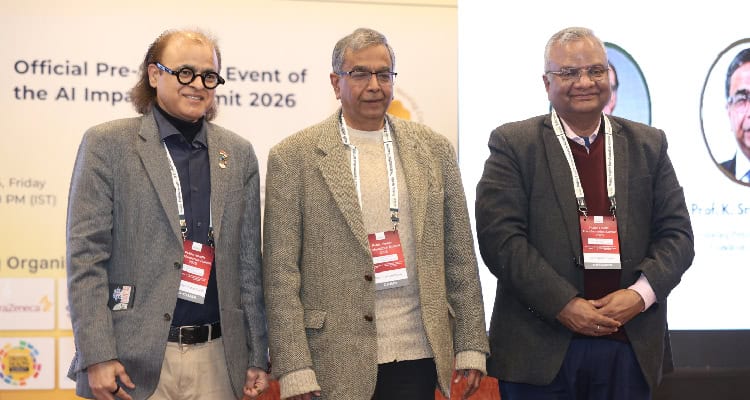

Over 250 public health leaders, researchers, and practitioners convened at the India International Centre for the Public Health Transformation Summit 2026 to discuss the future of India’s public health system. Recognised by the Ministry of Electronics and Information Technology (MeitY) as the Official Pre-Summit of the AI Impact Summit 2026, the event focused on shifting India’s public health from a reactive model to a rights-driven, technology-enabled discipline.
The Summit delivered concrete outcomes, including the announcement of India’s first Public Health Monitor, a Draft Planetary Health Policy Framework, and a reimagined digital public health curriculum designed to prepare a new generation of leaders fluent in epidemiology and technology. Nursing professionals participating in the Summit earned five CNE hours.
Senior diplomats and representatives from France, Indonesia, Sri Lanka, Iraq, Chad, Lithuania, Guinea, Togo, China, Benin, and Jamaica attended the Summit, highlighting India’s growing international engagement in public health dialogue.
Prof. K. Srinath Reddy, Founding President of the Public Health Foundation of India, opened the Summit, stating, “If Clinical medicine delivers health in retail, then Public Health delivers health in wholesale.” Co-chair Dr. Rajendra Pratap Gupta added, “Public Health needs to integrate digital, if it has to scale and we need to create a pipeline of future leaders who will lead this revolution & that remains the biggest challenge for public health.”
The morning panel addressed the state of public health in India. Dr. Narendra Kumar Arora, Executive Director of The INCLEN Trust International, said, “We need to move forward in a way that is evidence-based and not on assumptions.” Mathew Cherian, Chairperson of CARE India, commented on geriatric healthcare, stating, “If we provide age-friendly healthcare, then all of us in this room can live to be 100 years.” Dr. Harish Iyer, Director of Health R&D, Digital Innovations & AI at the Gates Foundation, added, “Technology can be deeply enabling. How do you make this enabling in the public health system is the challenge, and figuring out how to make it interoperable.” Dr. Girish N. Rao, Principal Investigator of the National Mental Health Survey, emphasised, “We are conveniently forgetting that there is no health without mental health, and this is not just an average or a mere slogan. Mental health is everybody’s business. The stress and the distress in the different disorders are now more evident than ever.” Mevish P. Vaishnav, President of Health Parliament, concluded, “Public Health is not just about hospitals and diseases. It is the condition in which people live—the air, water, food, mental well-being, ageing, and the systems that protect us or fail to protect us.”
Keynote addresses framed public health as central to India’s development. Dr. Vinod K. Paul, Member (Health), NITI Aayog, stated, “Data is only useful when you use it; when you store it, it has no value. Unless data is connected, interoperable, and actually used for planning, programming, and action, it does not serve its purpose.” Shri Bharat Lal, Secretary General, NHRC, emphasised, “Preventive healthcare through this approach is very important.” Dr. Sunil Kumar Barnwal, CEO, National Health Authority, highlighted digital public health, saying, “If we really want to build Viksit Bharat by 2047, we need to be a healthy Bharat, and a healthy Bharat will exist if we really promote integrated healthcare with many more technological solutions.” Smt. Vijaya K. Rahatkar, Chairperson, NCW, stated, “भारत केवल बीमारियों से नहीं लड़ रहा है, भारत स्वास्थ्य की एक नई व्यवस्था बना रहा है, और इस परिवर्तन के केंद्र में भारत की नारी शक्ति खड़ी है।”
The Public Health Monitor session, led by Prof. K. Srinath Reddy, Dr. Rajendra Pratap Gupta, and Dr. K. Madan Gopal, introduced a transparent, real-time framework for measuring public health outcomes and system capacity. Dr. Gopal noted, “One of the important challenges is understanding the data—what to collect and what is the importance of the data; that part of capacity is currently missing.” Prof. Reddy added, “What is not easy to measure does not get measured, even if it is important. And therefore, what gets measured gets repetitively incorporated; that gets into policy, that gets into programs.”
Sessions on Planetary Health and One Health highlighted environmental and animal health as core public health considerations. Shri Rajit Punhani, CEO, FSSAI, said, “We need to change this paradigm” of unhealthy food being cheaper than healthy food. Dr. Sunita Narain, Director General, CSE, noted, “Nobody is safe till everybody is safe.” Brigadier Jyothikumar S. Dharamadheeran, CEO, Brooke India, added, “Public health is what actually implements this concept on the ground.” Dr Rajiv Kumar Jain, Chair, SCETOH, stated, “We must create evidence first — only then can leadership and policy follow.”
The Digital Public Health session addressed technology-enabled solutions. Dr. Krishnan Ganapathy said, “Unlearning and relearning, in my opinion, is far more important than learning. Doctors today are not pre-AI or post-AI—we are living in the AI era.” Dr. Indu Bhushan highlighted system requirements, stating, “Anything that needs to be done at scale for large populations, digital is unavoidable.” Gopi Gopalakrishnan added, “Any system that does not have a self-correcting mechanism is doomed to failure.”
Panels on careers, industry engagement, and accountability included Dr. R.K. Srivastava, “Solutions from public health experts are only possible when young boys and girls are involved.” Dr. Sivaranjani Santosh added, “There are many regulatory loopholes, and these loopholes can be exploited by people with vested interests. So you, and only you, can remind the systems of what they are built for.” Annaswamy Vaidheesh, Former Executive Chairperson, Suven Pharmaceuticals, questioned, “The question is not whether pharma is doing good. The question is whether it is also seen to be doing good, and whether that is backed by outcome-based public health data.” Praveen Akkinepally, Country President, AstraZeneca India, reflected on long-term outcomes, “Public health is a constant process. You never reach perfection, and that is just the way it works.”
The summit concluded with an Open Mic session, where frontline workers and researchers shared challenges and innovations, reinforcing that transformation requires participation from all levels. Ms. Mevish P. Vaishnav, President of Health Parliament, noted that the Summit is “not as a culmination but as a launching pad.”
Dr. Gupta closed the Summit, stating, “Today, at the Public Health Transformation Summit 2026, leaders came from diverse fields for a frank discourse on public health. Now the real work begins, together, we must turn this conversation into action and transform public health.”
- Advertisement -