

Drilling down: Can India’s dental sector scale up?
Structural shifts driven by standardisation and digital adoption are reshaping dentistry in India,even as affordability,insurance gaps and access challenges persist


India’s dental sector, long dominated by standalone clinics and out-of-pocket spending, stands at an inflection point. The rise of organised chains, digital technologies, and shifting consumer behaviour are rewriting the rules. But critical barriers like thin insurance coverage, uneven access, and weak systemic integration continue to hold back scale.
A market on the move
For decades, India’s dental sector operated quietly on the margins of organised healthcare. The dominant picture was a neighbourhood clinic, a solo practitioner, and a patient walking in with acute pain. Today, that picture is changing, slowly but unmistakably. But today, that picture is changing, slowly.
As per Nexdigm Market Research, “India’s dental services market is valued at USD 2.5 billion in 2024, growing at an approximate CAGR of 8 per cent from 2024 to 2030.”
Sachin Katira, Co-Founder and CEO, Eka Dental Care mentions, “India’s dental market is growing steadily, driven by rising awareness, expanding urban middle-class incomes, and increased insurance penetration. Yet, utilisation remains stubbornly low. A significant chunk of the population still treats dental visits as reactive, not routine, something you do when the pain becomes unbearable, not before.”
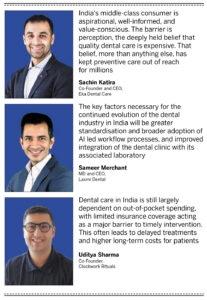
The barrier, as Katira notes, is rarely ignorance. “India’s middle-class consumer is aspirational, well-informed, and value-conscious. The barrier is perception, the deeply held belief that quality dental care is expensive. That belief, more than anything else, has kept preventive care out of reach for millions”, he adds.
Sameer Merchant, MD and CEO, Laxmi Dental also believes that, “India’s dental market is rapidly growing, driven by rising awareness about dental health and increasing demand for quality care in urban centres. The long-term outlook for growth remains strong.”
The organisation imperative
The most important shift underway in Indian dentistry is structural: the gradual transition from a fragmented, standalone-clinic model to an organised, chain-based ecosystem. While solo practitioners still account for the overwhelming majority of dental touchpoints, organised chains are gaining ground steadily, particularly in metro and Tier 1 cities.
Uditya Sharma, CoFounder, Clockwork Rituals shares, “There is a visible, albeit gradual, shift towards organised dentistry in India. While standalone clinics continue to dominate, organised chains and branded networks are steadily gaining ground, particularly in urban centres. This transition is largely being driven by increasing consumer preference for standardised, hygienic, and reliable care, along with greater trust in branded healthcare experiences. Additionally, the integration of technology in diagnostics and treatment planning, coupled with growing investor interest in scalable healthcare models, is accelerating the move towards a more organised ecosystem.”
The drivers of this transition are multiple. Consumers, particularly younger and urban ones, are seeking clinical environments that feel safe, standardised, and transparent. They want upfront pricing, professional ambience, and the assurance of consistent care.
Dr Achuth M Baliga, Medical Director, Happiest Pearls, observes this from the clinical front, “Yes, there is a clear and growing shift towards organised dentistry, particularly in metro cities. The sector is gradually transitioning from standalone clinics to corporate dental chains, driven by the need for standardisation, quality assurance, and scalability. Accreditation frameworks such as NABH are further reinforcing this shift by promoting consistent clinical and operational standards.”
As Laxmi Dental operates at the intersection of clinical and manufacturing ecosystems, Merchant views the organised shift as a business opportunity. “From our viewpoint, this has been accomplished by the increasing demand for consistency in services, and therefore more structured dental networks, with quicker uptake of technologies for the treatment planning process. All these changes will help build more standardised and efficient processes throughout the entire value chain.”
What’s driving demand?
India’s dental demand is not uniform. It cuts across three distinct segments i.e. preventive, curative, and cosmetic; each with its own growth dynamics and consumer profile.
Historically, curative care has dominated. Patients came in only when pain was unbearable, and procedures like root canals, extractions, and fillings drove the bulk of revenue. That model, while persistent, is being complemented by newer demand patterns.
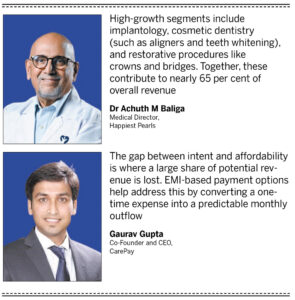
Dr Baliga highlights, “High-growth segments include implantology, cosmetic dentistry (such as aligners and teeth whitening), and restorative procedures like crowns and bridges. Together, these contribute to nearly 65 per cent of overall revenue. Consumer behaviour is evolving towards elective and aesthetic treatments, reflecting increased awareness, aspirational value, and willingness to invest in dental care.”
The cosmetic segment deserves particular attention. Driven by social media visibility, increasing aesthetic awareness, and the mainstreaming of procedures like aligners and teeth whitening, cosmetic dentistry is seeing some of the sharpest upticks in urban markets. Meanwhile, preventive care like dental check-ups, cleanings, scaling is growing among younger, more health-aware consumers who are beginning to treat oral health as part of a broader wellness routine.
Sharma contextualises the broader demand shift, “The demand landscape in India’s dental sector is evolving from being predominantly curative to a more balanced mix of preventive, curative, and cosmetic care. While curative treatments continue to account for a significant share due to historically unmet needs, there is a clear rise in preventive care adoption, especially among younger and urban consumers who are becoming more proactive about oral health. At the same time, cosmetic dentistry is witnessing strong growth, driven by increasing aesthetic awareness and lifestyle aspirations. Overall, consumer behaviour is shifting from a reactive approach to a more proactive and lifestyle-oriented view of oral care.”
There is also an epidemiological dimension to demand growth. Rising rates of lifestyle diseases like diabetes and gut disorders, combined with widespread tobacco use, are contributing to increased dental morbidity. This creates baseline demand though it also points to a public health challenge that the sector must engage with.
Technology as key enabler
Across every conversation about scaling India’s dental sector, technology emerges as the key enabler. From diagnostics to patient management, from chair-side to lab, digital tools are changing what is possible and what is efficient.
Outlining the technology stack that is reshaping clinical care, Dr Baliga says, “Key enablers include Electronic Medical Records (EMR), which enable seamless data portability and better patient management; CAD-CAM technology for precise and efficient dental restorations; AIpowered diagnostic imaging software, improving accuracy and speed of diagnosis; and teledentistry, expanding access and enabling remote consultations. Together, these innovations are helping standardise care, reduce turnaround times, and support multi-location scalability.”
According to Merchant, “Technology is having a dramatic impact on dentistry by improving both scalability and efficiency. At Laxmi Dental, we have seen how much more quickly, and accurately digital impressions, CAD/CAM processes and AI-enhanced design systems provide us with the results we need. Ultimately, these technologies are helping to link clinics and laboratories in new ways, creating a far more connected and expandable ecosystem.”
The implications for scalability are significant. When clinical protocols are digitised and standardised, a dental chain can maintain consistency across dozens of locations without relying solely on individual practitioner judgment. AI-assisted diagnostics reduce the margin for human error. Cloud-based management systems allow real-time performance monitoring across a network. The result is an operational model that can genuinely scale.
Sharma notes the broader systemic value of this technology integration, “Advances in digital diagnostics and imaging are improving accuracy and reducing treatment timelines, while AI-led tools are enhancing treatment planning and patient outcomes. Additionally, the rise of teledentistry and digital patient management systems is helping expand access and streamline operations. Collectively, these innovations are reducing dependence on individual practitioners, enabling standardisation of care, and improving overall efficiency across the value chain.”
For Katira, technology is not just a clinical tool but it is part of the business case for making dental care more accessible. “Technology helps clinics use their resources wisely and see patients without any problems. This means that people can get care no matter where they go. Technology is also helping clinics get bigger and better.”
The affordability gap: Insurance and financing as the missing link
If technology is the sector’s enabler, affordability is its most stubborn bottleneck. Majority of adults in India have dental caries, yet treatment rates remain low. The reason is straightforward: dental care in India is almost entirely out-of-pocket, and for a large segment of the population, it is simply too expensive.
Sharing his opinion, Katira shares, “India’s dental sector has problems with access and affordability. This is mainly because insurance does not cover much. Most dental treatments are to be paid by patients without any cost support, which makes them costly for many. This is especially worrying since over 90 per cent of adults in India have caries. Yet many put off treatment because it is too expensive and not easily available outside big cities. Making dental insurance cover more treatments will be key to making dental care cheaper. It will also encourage people to take care of their teeth before problems start.”
The insurance gap in dental care is one of the most cited structural problems in the sector. Unlike medical insurance, which covers hospitalisation and a growing range of outpatient services, dental insurance remains a peripheral offering typically excluded from standard health policies, rarely purchased as standalone cover. The result is that millions of Indians who have health insurance effectively have no dental coverage.
Merchant flags both the problem. He added, “Most dental treatment continues to be paid out-of-pocket which leads to people being delayed from getting dental care when they need it. At Laxmi Dental, we are also enabling more accessible care through EMI based options via partnerships like Fibe, while broader insurance inclusion will be critical to improve affordability and shift focus on preventive dentistry.”
The EMI model, as a bridge solution, is attracting significant attention. Gaurav Gupta, Co-Founder and CEO, CarePay, explains the precise problem it solves, ““For most clinics across the secondary healthcare industry, from dermatology to IVF, the biggest revenue leak does not come from lack of demand, it comes from drop-offs after consultation. Patients often reach the decision stage with clear intent, but hesitate when faced with a high upfront cost. This gap between intent and affordability is where a large share of potential revenue is lost. EMI-based payment options help address this by converting a one-time expense into a predictable monthly outflow. When patients see a treatment broken down into manageable instalments, the decision becomes easier and more immediate.”
“As we’ve seen at CarePay partnered clinics, structured financing at the point of care tend to see higher treatment acceptance and more consistent cash flows. It also shortens the cycle between consultation and payment, which improves operational efficiency. In that sense, EMIs are not just a payment tool, they act as a conversion layer that helps clinics capture demand that would otherwise remain unrealised”, Gupta added.
“The real growth opportunity in Indian dentistry isn’t in serving those who were already coming. It’s in unlocking the massive latent demand among those who have been opting out. Affordability paired with accessibility doesn’t just grow a business — it grows the entire category”, says Katira.
The broader insurance inclusion question, however, remains unresolved. Experts agree that expanding insurance coverage to dental care is essential for the sector to cross the affordability chasm at scale. But doing so requires parallel progress on digital adoption; clinic management systems, EMRs, and digitised billing to enable seamless data sharing and claims processing.
As Dr Baliga notes, “The major barriers to access and affordability include the rising cost of dental treatments and persistent patient concerns such as pain anxiety or phobia. Insurance inclusion will be a critical enabler for future growth, particularly as it can significantly improve affordability and drive patient volumes. However, for insurance to be effectively integrated, widespread adoption of digital systems across clinics will be essential to ensure seamless data sharing and claims processing.”
Access beyond urban India
Affordability is one dimension of the access problem. Geography is another. The concentration of quality dental care in metro and Tier 1 cities means that a large proportion of India’s population in Tier 2 and Tier 3 cities, and in rural areas has effectively no access to organised dental services.
Sharma stresses, “Despite the growth momentum, access and affordability remain significant challenges. Dental care in India is still largely dependent on out-of-pocket spending, with limited insurance coverage acting as a major barrier to timely intervention. This often leads to delayed treatments and higher long-term costs for patients. Furthermore, access to quality dental care remains uneven, particularly beyond metro cities. Expanding insurance inclusion will be critical in addressing these gaps, as it can improve affordability, drive early adoption of care, and support the overall formalisation of the sector.”
For organised chains, expansion beyond metros is both an opportunity and a challenge. The opportunity is clear: vast unserved markets with growing incomes and rising awareness. The challenge is operational like maintaining quality, managing talent, and achieving unit economics in markets where purchasing power is lower and infrastructure is thinner.
Technology particularly teledentistry and digital diagnostics could play a role in bridging the geographic gap, enabling remote consultations and preliminary diagnostics that reduce the need for in person visits for certain use cases. But physical infrastructure, trained dental professionals, and accessible clinic networks remain indispensable for actual care delivery.
The road to investment readiness
All the growth dynamics converge on a central question: when will India’s dental sector become truly investable at scale? The ingredients are visible with large latent demand, organised players gaining traction, technology enabling standardisation, and consumer behaviour shifting. But the structural scaffolding like insurance, regulation and capital is still being built.
Sharma frames the conditions for a sector-level transformation, “For India’s dental sector to evolve into a scalable and investment-ready healthcare vertical, a combination of structural and behavioural shifts will be required. Greater integration of dental care within mainstream healthcare, improved insurance coverage, and standardisation of treatment protocols will be essential. At the same time, increased adoption of technology and a stronger focus on preventive care can help create more sustainable and predictable demand. As organised players continue to expand and consumer awareness deepens, the sector is well-positioned to transition from a fragmented, treatment-led model to a more integrated and growth-oriented ecosystem.”
Dr Baliga mentions, “The evolution of dentistry into a scalable, investment-ready healthcare segment will be driven by a combination of factors—including the shift towards organised care, adoption of advanced technologies, standardisation through accreditation, and integration with insurance ecosystems.”
Merchant points to several concrete enablers,, “The key factors necessary for the continued evolution of the dental industry in India will be greater standardisation and broader adoption of AI led workflow processes, and improved integration of the dental clinic with its associated laboratory. Expanding outside of metropolitan areas and increasing the availability of affordable types of insurance will contribute to this growth. Some of the changes necessary to achieve these goals have already begun and collectively will enhance the dental profession in India creating a more organised, scalable and investment-ready industry.”
For Katira, “The biggest reason for growth will be the rise of large dental chains. They make dental care more accessible and standardised, which builds trust. At the same time, technology is improving how dentists diagnose and treat patients, making everything more efficient. Insurance is another factor, it reduces the cost burden, so more people are willing to seek treatment. Additionally, with increasing awareness about preventive care, people won’t wait for serious issues before visiting a dentist. And ultimately, all of this combined will drive the sector forward in the coming years.”
Way forward
India’s dental sector is not yet a fully organised, investmentready healthcare vertical. But it is moving in that direction, faster than most observers expected a decade ago. The entry of organised chains, the integration of digital technologies, the emergence of new financing models, and the gradual shift in consumer behaviour are collectively laying the groundwork for a more scalable and structured sector.
The barriers are real and significant: out-of-pocket dependence, thin insurance coverage, geographic concentration, and the inertia of a generation of patients who have never made dentistry a habit. Overcoming these will require coordinated action from providers, payers, policymakers, and technology companies.
But the market opportunity, if unlocked, is enormous. With over a billion potential patients and oral health prevalence rates that make the treatment gap staggering, India’s dental sector does not lack for demand. What it lacks is the systemic infrastructure to convert that demand into accessible, affordable, and high-quality care at scale.
The drill is running. The question is whether the sector can move fast enough to fill the cavity.
- Advertisement -
