

The long-term vision is to position Kerala as one of India’s leading MedTech hubs by 2032
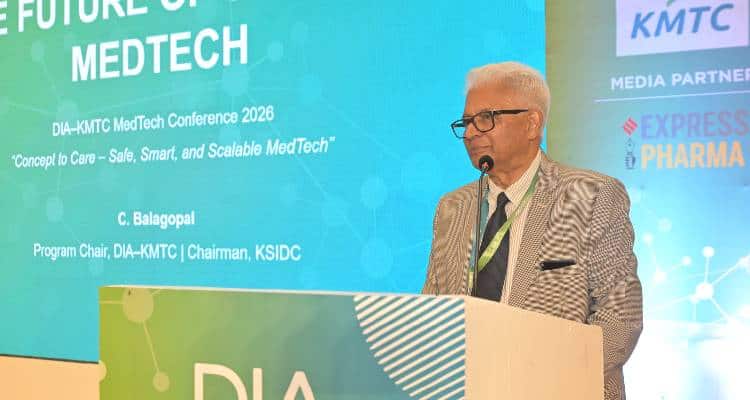
Balagopal Chandrasekhar, Chairman, Kerala State Industrial Development Corporation (KSIDC) in an interview with Kalyani Sharma, discusses the state’s MedTech ambitions, investment opportunities, policy priorities, and the importance of building trusted innovation ecosystems that can take products from concept to care at scale


Kerala has been actively promoting knowledge-driven industries. How important do you see MedTech becoming within the state’s larger industrial growth strategy?
MedTech is strategically important for Kerala because it aligns closely with the State’s core strengths — healthcare, human capital, research capability, engineering talent and digital systems. Unlike many traditional manufacturing sectors, MedTech innovation does not happen in isolation. Michael Porter’s cluster theory becomes especially relevant here because successful MedTech ecosystems require deep integration between healthcare institutions, industry, startups, universities, research centres and regulators. Kerala already possesses many of these foundational strengths. Through the Kerala Medical Technology Consortium (KMTC), the State is attempting to build an orchestrated ecosystem approach rather than a standalone industrial approach. The long-term vision is to position Kerala as one of India’s leading MedTech hubs by 2032, with an estimated industry opportunity of approximately USD 4.2 billion.
From an investment perspective, what are the biggest factors global and domestic MedTech companies are looking for before setting up operations in a state like Kerala?
MedTech companies evaluate far more than land and incentives. They look for access to clinical ecosystems, regulatory support, skilled talent, quality infrastructure, validation capabilities and long-term ecosystem maturity.
This sector is highly trustdriven and innovation intensive. Companies increasingly prefer locations where hospitals, clinicians, researchers, manufacturers and technology developers can collaborate closely. Kerala’s advantage lies in its strong healthcare system, high quality human resources, digital health maturity and research depth. The State’s ecosystem-driven approach through KMTC is also helping create stronger linkages across stakeholders, which is critical in MedTech.
India’s MedTech sector still faces challenges around scale and manufacturing competitiveness. What policy or infrastructure interventions are most urgently needed?
India needs to strengthen the entire MedTech value chain not just manufacturing capacity. The priority areas include testing and certification infrastructure, clinical validation pathways, component ecosystems, regulatory support systems, design-to-manufacturing capabilities and export readiness.
Manufacturing is, in any case, the lowest point in the “smile curve” of value addition and requires land, labour, power and water at scale. In the case of MedTech products, Kerala is already a major manufacturing hub for India, contributing over 15% of the country’s output by value. The larger opportunity now is to move further up the value chain into design, clinical validation, quality systems, advanced manufacturing, regulatory capability and globally trusted innovation.
MedTech cannot scale through isolated interventions because innovation, validation, manufacturing and adoption are deeply interconnected. What India requires now are integrated MedTech ecosystems where industry, healthcare institutions, academia, startups and government systems work in closer coordination. Shared infrastructure and translational platforms will become increasingly important if India wants to build globally competitive MedTech products at scale.
India’s MedTech sector still faces challenges around scale and manufacturing competitiveness. What policy or infrastructure interventions are most urgently needed?
India needs to strengthen the entire MedTech value chain not just manufacturing capacity. The priority areas include testing and certification infrastructure, clinical validation pathways, component ecosystems, regulatory support systems, design-to-manufacturing capabilities and export readiness.
Manufacturing is, in any case, the lowest point in the “smile curve” of value addition and requires land, labour, power and water at scale. In the case of MedTech products, Kerala is already a major manufacturing hub for India, contributing over 15% of the country’s output by value. The larger opportunity now is to move further up the value chain into design, clinical validation, quality systems, advanced manufacturing, regulatory capability and globally trusted innovation.
MedTech cannot scale through isolated interventions because innovation, validation, manufacturing and adoption are deeply interconnected. What India requires now are integrated MedTech ecosystems where industry, healthcare institutions, academia, startups and government systems work in closer coordination. Shared infrastructure and translational platforms will become increasingly important if India wants to build globally competitive MedTech products at scale.
How is KSIDC looking at partnerships between startups, research institutions and industry to strengthen Kerala’s MedTech innovation ecosystem?
KSIDC sees MedTech as an ecosystem-building exercise rather than a conventional industrial development initiative. The role of KMTC is particularly important here as an ecosystem orchestrator that helps bring together startups, healthcare institutions, clinicians, universities, research centres, manufacturers, investors and government stakeholders onto a common platform.
In MedTech, breakthroughs often happen at the intersection of disciplines. A startup may have an innovative idea, but clinical validation may require hospitals, product refinement may require engineering institutions, and scaling may require industrial partners and regulatory support. KMTC’s role is to reduce these silos and help accelerate the journey from concept to clinically trusted and commercially scalable products.
With healthcare becoming increasingly technology-led, do you see Kerala having the potential to emerge as a specialised hub for certain MedTech segments?
Yes. Kerala should focus on building leadership in selected high-potential segments where it has natural advantages. Areas such as medical electronics, software-enabled medical devices, assistive technology, diagnostics, digital health and specialised medical rubber-based products are particularly relevant. Kerala’s strong public healthcare network, early adoption of digital health systems, engineering talent base and clinical ecosystem provide a strong foundation for these specialised segments. The opportunity is not necessarily to compete on scale alone, but to build a globally credible ecosystem focused on quality, innovation and clinically relevant solutions.
India has the market size, engineering capability and policy momentum to build globally competitive MedTech products. States like Kerala can capitalise by focusing on ecosystem-led growth strengthening clinical partnerships, supporting translational research, improving quality and regulatory readiness, enabling advanced manufacturing and fostering collaboration across stakeholders. The future advantage in MedTech will not come only from low-cost manufacturing. It will come from the ability to build trusted ecosystems that can consistently take products from concept to care safely, smartly and at scale.
[email protected]
[email protected]
- Advertisement -
