

Yashoda Medicity introduces advanced VitalGo Total Lift bed technology
Prolonged bed rest in critically ill patients is associated with complications such as ICU-acquired weakness, muscle loss, respiratory compromise, delayed rehabilitation and longer hospital stays. The Total Lift Bed is intended to facilitate repeated verticalisation and graded weight-bearing sessions as part of rehabilitation protocols

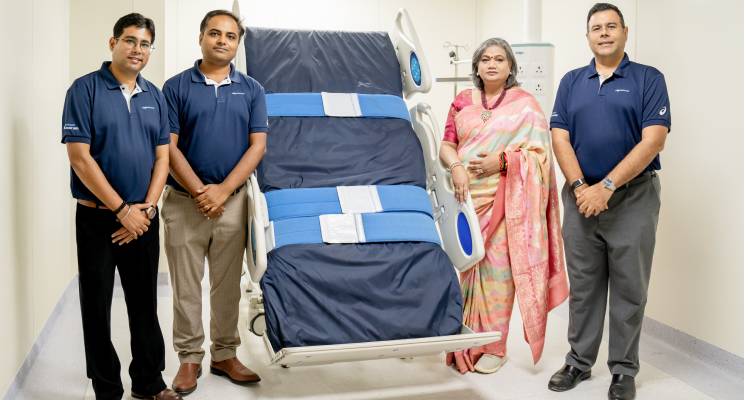

Yashoda Medicity has introduced the VitalGo Total Lift Bed (TLB), developed by Paramount Bed, as part of its critical care infrastructure. The technology is designed to support early rehabilitation, patient mobilisation and recovery for critically ill patients.
Unlike conventional ICU beds, the VitalGo Total Lift Bed incorporates an in-bed verticalisation system with an integrated weight-bearing control mechanism. It enables patients to be gradually moved from a lying position to an upright standing posture while remaining fully supported within the bed, allowing mobilisation to begin during intensive care where clinically appropriate.
Prolonged bed rest in critically ill patients is associated with complications such as ICU-acquired weakness, muscle loss, respiratory compromise, delayed rehabilitation and longer hospital stays. The Total Lift Bed is intended to facilitate repeated verticalisation and graded weight-bearing sessions as part of rehabilitation protocols.
Dr Upasana Arora, Managing Director, Yashoda Group of Hospitals said, “Critical care today is focused on survival as well as on restoring function and improving quality of recovery. The introduction of the VitalGo Total Lift Bed reflects our commitment to adopting globally recognised technologies that support evidence-based critical care practices. Moreover, early rehabilitation has emerged as an important component of intensive care, and such innovations enable our multidisciplinary teams to deliver more comprehensive and centered care.”
According to the hospital, verticalisation therapy may support respiratory function by improving lung recruitment, facilitating secretion clearance, enhancing ventilation-perfusion matching and oxygenation, and reducing the risk of aspiration and ventilator-associated pneumonia. Gradual upright positioning may also contribute to improved cardiovascular stability, circulation and a lower risk of thromboembolic complications.
The therapy may also support neurological recovery by improving alertness and reducing the incidence of ICU delirium through multisensory stimulation. In addition, regular repositioning and mobilisation may help reduce pressure-related skin injuries associated with prolonged immobilisation.
The technology can be used for patients receiving mechanical ventilation, extracorporeal membrane oxygenation (ECMO), mechanical circulatory support, and those recovering from major cardiothoracic, orthopaedic, abdominal, transplant or spinal surgeries. It may also be suitable for patients with neurological disorders, severe burns, critical illness myopathy and other conditions requiring prolonged intensive care.
The bed includes features such as powered patient boosting, automatic repositioning, integrated line management, multiple positioning options and safety mechanisms designed to support patient handling and reduce the physical strain on caregivers. Safety features include manual CPR release, safety dampers, subframe tilting for stability and compliance with IEC 60601-2-52 entrapment safety standards.
The introduction of the rehabilitation platform is expected to support multidisciplinary care involving intensivists, physiotherapists, respiratory therapists, rehabilitation specialists and nursing teams by facilitating early mobilisation as part of critical care management.
- Advertisement -