

GDHS 2026 delivers a boardroom wake-up call: Puts AI to a clinical test
Global healthcare leaders call for stronger clinical validation, responsible AI adoption and workforce readiness as India accelerates its digital healthcare transformation

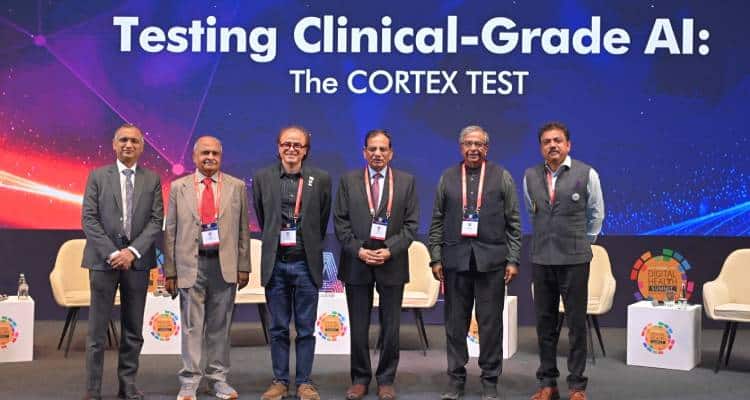

Artificial intelligence demonstrated strong capabilities in analysing a clinical problem at the recently held Global Digital Health Summit (GDHS) 2026, but experienced doctors showed greater sensitivity to clinical context and recommended fewer unnecessary tests and medicines. The live assessment highlighted a critical question facing healthcare systems worldwide: how can AI improve medical decision-making without compromising patient safety and human judgement?
The fifth edition of GDHS, recently held at Bharat Mandapam, New Delhi, brought together policymakers, medical professionals, hospital executives, researchers and global technology leaders to examine the practical implementation of AI in healthcare. Organised under the theme “Implementing Artificial Intelligence: AI in Action,” the summit recorded its highest-ever participation, with 2,410 registrations against a seating capacity of 2,000.
A major highlight was world’s first on-site and live “Testing Clinical-Grade AI: The CORTEX TEST,” which brought artificial intelligence and India’s topmost clinician leaders to assess a clinical problem- this was for the first time in the world , where AI was tested for being clinical grade online and on site. While AI demonstrated the potential to support medical decision-making, human experts showed greater sensitivity to clinical context and recommended fewer unnecessary investigations and medications. The exercise highlighted the need for rigorous clinical validation, physician oversight and patient safety safeguards as healthcare organisations increasingly integrate AI into clinical practice.
The assessment featured Dr Vinod Paul, Prof. K. Srinath Reddy, Dr Nitish Naik, Dr R.K. Srivastava, Col. (Dr) Mohan Kubendra and Dr Rajendra Pratap Gupta. Over 2000 global leaders and delegates were in the room to witness AI nearly approaching human capability for practice of medicine.
“If doctors don’t use technology today, technology will not need them tomorrow,” said Dr Rajendra Pratap Gupta, Chairman, GDHS 2026, highlighting the urgency of preparing healthcare professionals for an AI-enabled future.
Dr Gupta also unveiled The Theory of Technological Value: The Three Laws of Elimination, a framework challenging conventional approaches to assessing the value of technology in the age of artificial intelligence.
Changing patient behaviour emerged as another important theme, with discussions highlighting how people are increasingly using AI-powered tools to seek health information and guidance. Healthcare leaders stressed that hospitals and medical professionals must adapt to these changing expectations while ensuring that technology supports, rather than replaces, trusted clinical relationships.
Senior government representatives outlined India’s progress in digital healthcare and the opportunities for deploying AI across public health systems. Madhukar Bhagat, Joint Secretary (e-Health), Ministry of Health and Family Welfare, discussed the role of eSanjeevani and the Ayushman Bharat Digital Mission (ABDM), emphasising the importance of data privacy and human dignity.
Nikhil Dhongari, Director, National Health Authority, highlighted how agentic AI could accelerate digital health integration, citing an example in which hospital system integration with ABDM was reduced from months to a single day. He also discussed indigenous voice-to-text capabilities supporting more than 50 languages, highlighting opportunities to make digital healthcare more accessible across India’s linguistically diverse population.
Vaidya Rajesh Kotecha, Secretary, Ministry of Ayush, discussed AI’s potential in digital Ayurveda and integrative precision medicine, while Aseem Sahu, Deputy Drugs Controller General of India, highlighted opportunities for AI-driven personalised pharmaceutical innovation.
Global healthcare leaders emphasised that the next phase of AI adoption must move beyond pilot projects towards measurable improvements in clinical outcomes, hospital efficiency and patient care.
Arun Kumar Bhaskara-Baba, CIO, Mayo Clinic, discussed the integration of AI into clinical workflows, while Maneesh Goyal, COO, Mayo Clinic Platform, identified large-scale deployment as a key challenge. Prof. Ran D. Balicer, Deputy Director-General and CIO, Clalit Health Services, stressed the importance of evidence-based implementation and clinical validation before AI solutions are adopted at scale.
“The future of medicine will be digital, but its soul must remain profoundly human,” said Dr Viviana Martínez-Bianchi, President, World Organization of Family Doctors (WONCA), underscoring the need to preserve human-centred care as technology transforms healthcare delivery.
Indian healthcare innovation also featured prominently, with demonstrations of AI-enabled ECG screening, chronic disease management, early autism screening and digital solutions supporting doctors and healthcare providers. Participating organisations included Narayana Health, Eka.Care, Butterfly Learnings, Healthians and Novartis India, reflecting the expanding role of technology across diagnostics, treatment and patient management.
The implications of AI for healthcare professionals were another major focus. Dr T. Dileep Kumar, President, Indian Nursing Council, highlighted the importance of equipping nurses with digital skills while ensuring that AI strengthens professional judgement rather than replacing it. Discussions involving healthcare accreditation, legal and cybersecurity experts also addressed data protection, accountability and the infrastructure required for safe AI deployment.
The summit’s wider programme included the Global Nursing Summit, HIMSS CIO Leaders meeting, Conversational AI for Healthcare workshop, a national summit on mental health in the digital age and an Outlook 2027 Leaders Roundtable co-chaired by Prof. Ran Balicer and Dr. Neena Pahuja.
Mevish P. Vaishnav, President, GDHS, emphasised that healthcare transformation must place people and ethics alongside technological advancement.
Concluding its fifth edition, GDHS 2026 identified clinical validation, reliable health data, workforce preparedness, patient safety and responsible implementation as critical priorities for healthcare organisations. The discussions highlighted that the future of AI in healthcare will depend not merely on technological capability, but on its ability to deliver measurable improvements in care while preserving the clinical judgement and human trust on which healthcare depends.
- Advertisement -