

GEMS 2026 puts the spotlight on AI and the future of emergency medicine
Microsoft Chief Scientist Dr Eric Horvitz delivers keynote on AI and the future of emergency medical systems

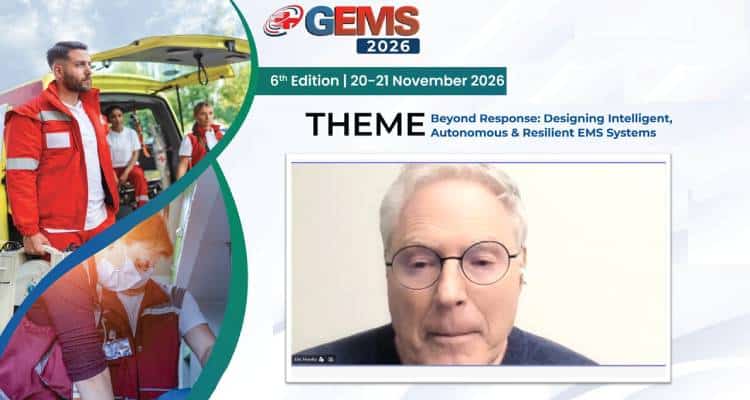

The 6th Global Summit on Emergency Medical Services (GEMS 2026) witnessed Dr Eric Horvitz, Chief Scientific Officer, Microsoft, delivering a international keynote lecture on “AI, Intelligence and the Future of Emergency Medical Systems.”
Addressing the global emergency medicine and EMS community during the virtual edition of GEMS 2026, Dr Horvitz explored the rapidly evolving relationship between artificial intelligence, clinical intelligence and healthcare delivery. His address offered an important perspective on how AI can move beyond being a technological tool to become an intelligent collaborator in clinical decision-making, particularly in complex, time-critical and information-intensive environments such as emergency medicine.
Dr Horvitz is one of the most distinguished global pioneers in artificial intelligence. An MD and PhD graduate of Stanford University, he serves as Chief Scientific Officer at Microsoft, leading initiatives at the intersection of science, technology and society, with particular emphasis on artificial intelligence, biosciences and healthcare. His pioneering research has advanced AI in perception, reasoning, decision-making under uncertainty, machine learning and human–AI collaboration. His work has contributed to real-world applications across healthcare, transportation, aerospace, operating systems and other sectors.
During his keynote, Dr Horvitz brought attention to the growing evidence and practical applications of clinician–AI collaboration. Drawing on research published in npj Digital Medicine, he highlighted the potential of collaborative AI workflows to support diagnostic reasoning, demonstrating how human clinicians and AI systems can complement each other’s capabilities rather than function independently.
A particularly relevant part of his presentation examined the application of AI in emergency medicine, including radiology triage, sepsis recognition, front-door triage, AI-enabled ECG interpretation and ambient clinical documentation. He discussed how AI-supported radiology workflows can help identify time-critical conditions, including large-vessel occlusion stroke and pulmonary embolism, and potentially improve clinical prioritisation and diagnostic turnaround times.
His presentation also explored the changing landscape of AI-assisted radiology triage, including evidence on its impact on reporting turnaround times and diagnostic performance in selected clinical applications. These developments are particularly relevant to emergency departments, where rapid recognition, prioritisation and clinical decision-making can significantly influence patient outcomes.
Another important theme was the relationship between diagnostic accuracy, resource utilisation and the economics of healthcare. Dr Horvitz presented perspectives on how AI-enabled systems may support more efficient diagnostic pathways while balancing clinical accuracy, costs and accessibility. His overarching message highlighted the importance of designing AI systems that strengthen clinical intelligence and human decision-making.
Dr Horvitz’s contributions to artificial intelligence have received international recognition, including the Feigenbaum Prize and the Allen Newell Award. He is an elected Fellow of the National Academy of Engineering, Association for Computing Machinery, Association for the Advancement of Artificial Intelligence, American Association for the Advancement of Science and several other prestigious scientific and academic organisations. He has also served on the US President’s Council of Advisors on Science and Technology and held leadership positions within the global AI research community.
Prof. (Dr) Tamorish Kole, Organising Chair, GEMS 2026, said, “Having Dr. Eric Horvitz address GEMS 2026 is a defining moment for our global emergency medicine community. Artificial intelligence is rapidly reshaping healthcare, and emergency medicine is one of the areas where its impact could be transformative. His insights on human–AI collaboration, intelligent decision-making and the application of AI in clinical workflows provide an important direction for how we must prepare our emergency medical systems for the future. We must move from simply digitising emergency care to designing intelligent systems that anticipate, assist and respond. The ultimate objective must remain better clinical decisions, faster interventions and more lives saved.”
The keynote was among the major highlights of GEMS 2026, organised under the theme “Beyond Response: Designing Intelligent, Autonomous and Resilient EMS Systems.” The virtual summit brought together international experts and participants from eight countries, creating a global platform for discussing the future of emergency medical services, healthcare technology, disaster resilience and integrated emergency care.
- Advertisement -