

Thyrocare launches ‘Bharat Aarogyam Score’ on World Health Day, highlights widespread silent health risks
Analysis of 93 lakh+ preventive health checkups shows early signs of multiple health conditions, with risks beginning as early as the 20s.


On the occasion of World Health Day, Thyrocare Technologies, a leading healthcare diagnostics company in India to have achieved 100% NABL accreditation across all its laboratories, has launched its Bharat Aarogyam Score, one of India’s largest real-world preventive health analysis, based on over 93 lakh health checkups conducted between 2023 and 2025. The findings highlight a widespread prevalence of silent health risks across the population, with more than 9 out of 10 individuals showing early signs of at least one health condition and a majority exhibiting multiple overlapping risk factors.
Bharat’s Aarogyam Score evaluates 10 key health condition groups, including:
- Cancer Risk Indicators (CA-125, CA 15.3, CA 19.9, CEA, PSA)
- Diabetes (HbA1c)
- Heart Health (Non-HDL Cholesterol, Triglycerides)
- Low Hemoglobin
(Hemoglobin)
- Iron Status (Iron)
- Kidney Function (Creatinine, eGFR, Uric Acid, BUN)
- Liver Function (Bilirubin
Direct, GGT, SGOT, SGPT)
- Thyroid Function (TSH)
- Vitamin D Deficiency (Vitamin D)
- Vitamin B12 Deficiency (Vitamin B12)
Multiple Health Risks Are More Common Than Expected: The report further highlights that health risks rarely occur in isolation. As per the analysis, more than 9 in 10 individuals show risk for at least one condition, over 8 in 10 for at least two conditions, over 6 in 10 for at least 3 conditions, nearly 4 in 10 for at least 4 conditions and nearly 2 in 10 for five or more conditions, indicating that multiple health risks are becoming increasingly common.
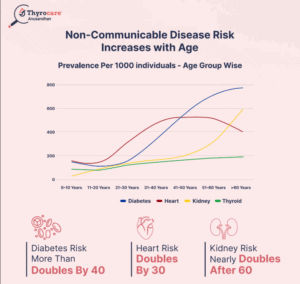
Non-Communicable Disease Risk Increases with Age:
The analysis shows that the rise in non-communicable disease risk starts earlier than commonly perceived, particularly for heart health and diabetes. Both conditions show a sharp uptick in the 21–40-year age group, with heart risk doubling by the 30s and diabetes risk more than doubling by the 40s. Kidney risk nearly doubles after age 60, while thyroid imbalance shows a steady upward trend across age groups. Together, these patterns indicate that health risks build gradually over time, highlighting the importance of early and regular preventive assessment.
Health Risk Trends by Year
Health risk trends have remained largely stable from 2023 to 2025, indicating no major shifts in overall disease prevalence.
Analysis of gender-based health risks shows that low hemoglobin prevalence is ~2.5× higher in females vs males. Males show 1.5× higher prevalence of liver marker abnormalities vs
females. Contrary to common perception, thyroid imbalance is only 1.4× higher in females vs males, while Vitamin B12 deficiency is 1.4× higher in males vs females.
Commenting on the Bharat Aarogyam Score report, Rahul Guha, MD & CEO, Thyrocare, shared, “India is not sick, India is unaware. Our data from 93 lakh annual health checkups tells us that 9 out of 10 people carry silent health risks they know nothing about. A country cannot be healthy by accident. Prevention must become a habit, not an afterthought and that shift begins the moment someone knows their numbers. The opportunity for India isn’t better hospitals. It’s better awareness.”
Rajdeep Panwar, Chief Commercial Officer, Thyrocare, said, “The Bharat Aarogyam Score not only shows how common individual conditions are but also highlights overlapping risks, stressing the need for a holistic approach. By turning complex health data into clear, actionable insights, it empowers individuals to take charge of their health.”
Dr. Preet Kaur, Chief Scientific Officer, Thyrocare, said, “The Bharat Aarogyam Score is a wake-up call we can no longer ignore. Heart disease and diabetes are no longer conditions of middle age; they are quietly taking root in people in their 20s and 30s. This shift demands a fundamental rethink of healthcare from episodic treatment to continuous, preventive vigilance.”
As India’s health landscape continues to evolve, the analysis highlights the need for greater awareness around preventive healthcare, where early detection and informed action can play an important role in improving long-term health outcomes.
- Advertisement -