

Jupiter Hospital deploys India’s first healthcare chiller plant optimiser by Johnson Controls India
The platform provides real-time visibility into plant operations and power consumption.

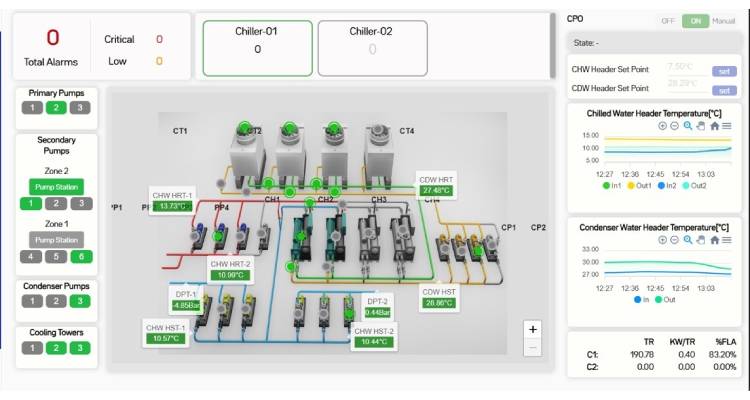

Jupiter Hospital, Dombivli, Thane, has implemented India’s first healthcare deployment of Johnson Controls India’s Chiller Plant Optimiser (CPO), bringing artificial intelligence into one of the most critical yet often overlooked areas of hospital infrastructure—cooling systems.
Designed as a fully on-premises solution, the CPO processes and stores all operational data within the hospital premises, without relying on the cloud. This ensures high levels of cybersecurity and data privacy, a key requirement for healthcare environments.
Cooling infrastructure in hospitals extends far beyond comfort. Critical spaces such as operation theatres, ICUs, blood banks, pharmacies and imaging suites depend on tightly controlled temperature, humidity and air quality. Stable cooling is also essential for the reliable operation of high-value diagnostic equipment such as MRI and CT systems. Any disruption can affect clinical workflows, equipment uptime, medication storage and infection-control environments.
HVAC systems account for 40–60% of a hospital’s total energy consumption, making them one of the largest contributors to operating costs. The chiller plant alone can account for up to 35% of a hospital’s electricity consumption.
The AI-driven CPO integrates and automatically controls the entire chiller ecosystem, including chillers, primary pumps, condenser pumps and cooling towers. Using real-time adaptive controls, the system continuously adjusts equipment performance based on cooling demand and ambient conditions.
Hospital cooling demand changes significantly through the day. During peak hours, demand can reach 450–500 TR (Tonnes of Refrigeration), while late-night loads can reduce to 220–250 TR. Traditionally, matching plant performance to these varying loads requires manual intervention. The CPO automates these adjustments, enabling the plant to operate at an efficiency of 0.72–0.75 kW/TR while maintaining precise environmental conditions.
The platform provides real-time visibility into plant operations and power consumption. Engineering teams can remotely monitor performance, receive control updates and track operational changes instantly. Every optimisation decision taken by the AI server generates notifications and control messages, ensuring complete transparency and traceability.
Compared with traditional manual systems, the Chiller Plant Optimiser is expected to deliver energy savings of 15–20% on chiller plant consumption. Based on current estimates, this translates into an annual reduction of 127,500 kg of CO₂ emissions, supporting the hospital’s sustainability and ESG goals.
Neelesh Shinde, Group Chief Technical Officer & Head – Projects, Jupiter Hospital, Dombivli, Thane, said, “In a hospital environment, Cooling isn’t a comfort system- it’s a clinical infrastructure. Patient safety, infection control and the performance of critical medical equipment depend on stable temperature and humidity conditions. The AI-driven Chiller Plant Optimiser enables real-time adaptive control across the cooling ecosystem, helping us maintain these conditions while improving energy efficiency and operational reliability.”
“The system continuously analyses plant behaviour, identifies performance deviations and enables faster corrective action. Its fully on-premises architecture ensures that operational data remains within the hospital network, delivering both cybersecurity and AI-driven optimisation. As hospitals move toward smarter infrastructure, technologies such as predictive maintenance, digital twins and self-learning systems will play an increasingly important role in improving resilience and sustainability.” He added.
As climate events become more frequent and healthcare facilities face rising energy demands, resilient infrastructure is becoming a strategic priority. AI-enabled systems can help hospitals anticipate demand surges, optimise equipment usage and maintain uninterrupted operations during periods of peak stress.
- Advertisement -