

Robotic joint replacement in India: Where technology improves precision and where surgeon judgement remains decisive
Dr Mayur Rabhadiya, Orthopedic & Robotic Joint Replacement Surgeon, Mumbai highlights Robotic systems can improve planning and execution accuracy, but they do not replace clinical judgement. For hospitals, the real question is whether the technology is embedded within a safe, trained, auditable and economically responsible joint-replacement programme.



Robotic systems are becoming increasingly visible in joint replacement programmes across India. For patients, the word “robotic” can imply that a machine performs the operation autonomously or that the technology itself guarantees a faster recovery. For hospitals, it can become a marker of modernity and competitive positioning. Both interpretations are incomplete.
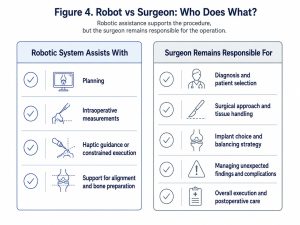
Contemporary robotic systems used in knee and hip arthroplasty are surgeon-controlled planning and execution tools. They may improve measurement, implant-positioning accuracy and reproducibility, but they do not independently determine whether surgery is indicated, which alignment target is appropriate, how the joint should be exposed, how soft tissues should be handled, or how complications should be managed. These decisions remain clinical and surgical.
The central question for Indian hospitals should therefore not be, “Should we buy a robot?” It should be, “Can we build a safe, high-volume, auditable joint-replacement programme in which robotic assistance adds measurable value?”
Precision is the clearest benefit
The strongest and most consistent evidence for robotic-assisted total knee arthroplasty relates to technical accuracy. A 2025 meta-analysis of 21 randomised controlled trials involving 2,692 patients found fewer mechanical-alignment outliers and less deviation from the planned neutral mechanical axis with robotic assistance. However, the same analysis found no significant advantage in commonly used WOMAC or Oxford Knee Scores across several follow-up periods, and robotic procedures took longer on average [1].
A similar pattern is seen in total hip arthroplasty. A 2025 systematic review and meta-analysis reported greater accuracy of implant placement with robotic-assisted hip replacement, but not consistently superior clinical outcomes compared with conventional techniques [2].
This distinction matters. Technical accuracy is a valid outcome, particularly when it reduces unintended deviations from a surgical plan. Yet an accurately executed plan is not necessarily the right plan for every patient. Robotics improves the ability to achieve a chosen target. It does not decide whether that target is appropriate.
The target still requires judgement
Knee replacement is moving beyond a single alignment philosophy. Mechanical, kinematic, restricted kinematic and functional-alignment strategies each attempt to reconcile implant positioning with individual anatomy, ligament balance and safe boundaries. Robotic systems can help surgeons model and execute these strategies more precisely, but the optimal approach remains under study. Even within robotic surgery, evidence comparing alignment philosophies is evolving, and long-term safety data for newer personalised strategies remain limited [3].
The surgeon must interpret deformity, bone loss, ligament competence, patellar tracking, implant design and the consequences of changing joint-line orientation. A robot can display measurements and simulate adjustments. It cannot take responsibility for the trade-offs.
The same principle applies to the surgical approach. Robotic assistance and minimally invasive or muscle-sparing exposure are separate components of the operation. The robotic platform may support planning and bone preparation, but it does not determine how the quadriceps mechanism is handled, how much exposure is required, or whether a smaller approach is safe in a particular knee. Recovery claims should not conflate these distinct factors.
Recovery is a pathway, not a device feature
Early recovery after joint replacement depends on much more than component alignment. Patient selection, preoperative function, diabetes control, anaemia, nutrition, pain sensitisation, expectations, anaesthesia, multimodal analgesia, tissue handling, blood management, physiotherapy and social support all influence the result.
The American Academy of Orthopaedic Surgeons’ guideline on surgical management of knee osteoarthritis concluded that short-term function, outcomes and complications were not significantly different between robotic-assisted and conventional knee arthroplasty in the evidence available for its guideline [4]. This does not mean robotic technology has no value. It means hospitals and clinicians should avoid presenting technical precision as a guarantee of less pain, faster walking, greater satisfaction or longer implant survival.
For patients, the most important discussion remains whether the diagnosis and severity of disease justify replacement, what non-operative options remain, what realistic outcomes can be expected, and which individual factors may slow recovery or increase risk.
Adoption should be treated as clinical governance
A robotic arthroplasty programme is not simply a capital purchase. It is a change in workflow involving surgeons, theatre nurses, technicians, anaesthetists, physiotherapists, sterile processing, biomedical engineering and hospital administration.
Learning-curve reviews show that operative efficiency improves with experience. A 2025 systematic review and meta-analysis reported a median learning curve of approximately 17 cases for robotic-assisted total knee arthroplasty, with operative time decreasing as teams moved from learning to proficiency. Importantly, the learning phase did not appear to produce clinically significant deterioration in radiological outcomes, patient-reported outcomes or complications, but hospitals still need structured training and realistic theatre scheduling [5].
Safe implementation should include proctored initial cases, predefined conversion plans if the system cannot be used, conventional instruments immediately available, regular review of registration errors and workflow delays, and a clear policy for documenting deviations from the planned procedure.
Hospitals should also separate platform performance from programme performance. A technically capable system can still deliver poor value if case volumes are low, teams are inconsistent, data are not audited, or the technology is used primarily as a marketing label.
Measure outcomes that matter
Before introducing a robotic platform, hospitals should define what success will mean. Alignment accuracy alone is insufficient. A balanced dashboard should include operative time and turnover time; registration failures and intraoperative abandonment; transfusion, length of stay, readmission, infection and reoperation; patient-reported pain, function and satisfaction; discharge destination and rehabilitation milestones; implant-positioning accuracy and alignment outliers; and total episode cost, including consumables, imaging, service contracts and post-acute care.
Economic evidence remains heterogeneous. A recent systematic review of economic evaluations found that cost-effectiveness depended heavily on surgical volume, patient characteristics, follow-up duration and the assumptions used in modelling [6]. Results from one country or reimbursement model cannot be applied directly to another. For Indian hospitals, transparent local costing and realistic case-volume projections are more useful than imported headline claims.
A practical adoption framework
| Domain | Question for leadership | Evidence of readiness |
| Clinical need | Which patients or anatomical problems are expected to benefit? | Defined indications and selection criteria |
| Team readiness | Are surgeons, theatre staff, engineers and rehabilitation teams trained together? | Proctoring, simulation and team protocols |
| Volume | Is annual caseload sufficient to maintain proficiency and distribute fixed costs? | Realistic volume forecast and scheduling plan |
| Measurement | Which clinical, technical and economic outcomes will be audited? | Baseline data and prospective dashboard |
| Resilience | What happens if registration, equipment or technical support fails? | Conventional backup instruments and conversion protocol |
| Communication | Are consent and marketing statements aligned with evidence? | No guarantees regarding pain, recovery or longevity |
The robot should strengthen a sound programme
Robotic assistance represents an important advance in joint replacement because it can improve planning, measurement and reproducibility. In complex anatomy or when personalised alignment is being used within defined safety boundaries, that information can be particularly valuable.
However, the presence of a robot is not proof of surgical quality, and the absence of one does not make conventional joint replacement inferior. A well-indicated, well-executed conventional operation by an experienced team remains evidence-based care.
The most defensible model for India is neither technology rejection nor technology-led marketing. It is disciplined adoption: use robotics where it adds information and control, retain surgeon accountability for every clinical decision, audit outcomes transparently, and judge value across the entire patient pathway.
References
-
Mostafa O, Malik M, Qayum K, et al. Robotic-assisted versus conventional total knee arthroplasty: a systematic review and meta-analysis of alignment accuracy and clinical outcomes. Ann Med Surg (Lond). 2025;87(2):867-879. doi:10.1097/MS9.0000000000002919.
-
Bensa A, Pagliazzi G, Miele A, et al. Robotic-assisted total hip arthroplasty provides greater implant placement accuracy and lower complication rates, but not superior clinical results compared to the conventional manual approach: a systematic review and meta-analysis. J Arthroplasty. 2025;40(7):1921-1931. doi:10.1016/j.arth.2024.12.014.
-
Giovanoulis V, Vasiliadis AV, Andriollo L, et al. Functional alignment in robotic total knee arthroplasty provides favourable outcomes and minimal early revisions: a systematic review and meta-analysis. Knee Surg Sports Traumatol Arthrosc. 2025. doi:10.1002/ksa.70226.
-
American Academy of Orthopaedic Surgeons. Surgical Management of Osteoarthritis of the Knee: Evidence-Based Clinical Practice Guideline. Published December 2, 2022.
-
Abdel Khalik H, Abesteh J, Aldawodi M, Khanna V, Adili A. The learning curve of robotic-assisted total knee arthroplasty: a systematic review and meta-analysis. J Robot Surg. 2025;19(1):456. doi:10.1007/s11701-025-02576-y.
-
Gao Y, Yang Y, Li Z, et al. Systematic review of health economic evaluation of robot-assisted hip and knee arthroplasty. Health Econ Rev. 2025;16(1):7. doi:10.1186/s13561-025-00701-z.
- Advertisement -
