

Eye Care: India’s Next Growth Frontier
India’s eye-care sector is expanding beyond major metros but the next phase will depend on how effectively the industry balances scale, access, affordability and clinical quality



India’s eye-care market is broadening beyond cataract as retina, glau – coma, refractive care and paediatric ophthalmology gain ground. Organised networks are expanding into smaller cities, technology is changing diagnosis and treatment, and the next phase of growth will depend on taking specialised care closer to patients without compromising clinical quality, affordability or outcomes.
For decades, cataract sur – gery has been the volume an – chor of India’s eye-care ecosys – tem. That role is unlikely to change in the near term. But the market around it is changing steadily
An ageing population, the growing burden of diabetes, in – creased screen exposure, rising awareness and greater acceptance of preventive eye examinations are bringing more patients into the system. At the same time, patients are increasingly seeking care for conditions that require longer term monitoring rather than a single procedure.
The result is a market that is becoming more specialised, more organised and increas – ingly technology-enabled.
Badrinarayan Srikanth, Group CEO, Maxivision Super Speciality Eye Hospitals, sees the sector at a significant stage of transition.
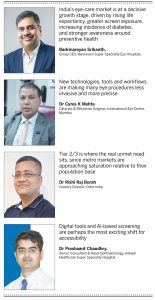
He mentioned, “India’s eyecare market is at a decisive growth stage, driven by rising life expectancy, greater screen exposure, increasing incidence of diabetes, and stronger awareness around preventive health. Cataract care remains significant, but demand is widening across retina, glaucoma, cornea, refractive cor – rection and paediatric ophthalmology.”
The widening demand is important because it changes the way providers have to think about the market. Cataract can often be ad – dressed through a defined sur – gical pathway. Conditions such as glaucoma, diabetic retinopathy and retinal disorders re – quire continuing engagement, monitoring and, in many cases, repeated interventions.
Dr Cyres K Mehta, Cataract & Refractive Surgeon, International Eye Centre, Mumbai, points to the change in patient behaviour as another factor behind the mar – ket’s evolution.
According to him, “India’s eye-care market has come a long way. Earlier, patients often visited an ophthalmologist only when they had a prob – lem, such as irritation or blurred vision. Today, aware – ness about eye health is grow – ing. Patients are more regular with eye check-ups and are more aware of the need for early diagnosis.”
This shift towards earlier engagement could prove important for both clinical out – comes and the economics of eye care. Earlier diagnosis cre – ates opportunities for inter – vention before vision loss becomes advanced, while regular monitoring can help manage chronic conditions over longer periods.
The market is also moving away from a fragmented model towards more structured de – livery networks. Organised providers, backed by capital and professional management, are increasingly looking at ophthalmology as a scalable healthcare category.
Dr Rishi Raj Borah, Country Director, Orbis India, describes this transition as a broadening of the specialty mix.
He said, “India’s eye-care sector is moving from a vol – ume-driven, cataract-centric model to a more diversified specialty ecosystem. Cataract will remain the largest proce – dural category given the size of the ageing population. Demand is becoming increasingly di – verse, with growing attention to glaucoma and retinal disor – ders, diabetic retinopathy, corneal disease, paediatric ophthalmology, and refractive errors, pushing demand into sub-specialities once treated as niche.”
The next market is out – side the metros
While metropolitan markets continue to account for a substantial share of organised eye care, the next phase of expansion is increasingly being linked to Tier 2, Tier 3 and district markets.
The opportunity is straightforward. Large sections of India’s population still do not have convenient access to specialised ophthalmic services. But taking a metropolitan model and replicating it in a smaller city is not necessarily straightforward.
Dr Prashaant Chaudhry, Senior Consultant & HeadOphthalmology, Aakash Healthcare Super Speciality Hospital sees a clear mismatch between the supply of specialised care and the geography of demand.
He believes that that’s where the real headroom is. “Metro markets are getting saturated and competitive, while Tier 2 and Tier 3 cities have enormous unmet need, often with a single overworked ophthalmologist serving an entire district.”
The challenge is not simply identifying demand. Smaller markets have different economics, workforce constraints and referral patterns. Specialist availability can be limited, while equipment and infrastructure costs remain substantial.
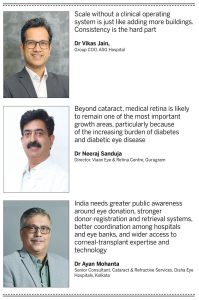
Dr Vikas Jain, Group COO, ASG Hospital, puts the strategic importance of smaller markets quite directly.
He stresses, “The next decade of organised eye care will be won in Tier 2, Tier 3 and district markets, not by adding another flagship centre in a metro.”
For organised providers, this changes the expansion equation. Instead of concentrating investment in large urban hospitals, networks have to consider a combination of full-service centres, satellite facilities, diagnostic-led units and referral arrangements.
Dr Neeraj Sanduja, Director, Viaan Eye & Retina Centre, Gurugram, points to the scale of unmet demand while also underlining the need for a different operating model. He said, “Tier 2 and Tier 3 cities represent a significant opportunity for organised eye care because a considerable amount of unmet demand exists outside the major metros. Patients in these markets increasingly seek reliable diagnosis, modern surgical options and access to specialists closer to home.”
That demand, however, cannot be converted into sustainable growth simply by adding physical capacity. The clinical ecosystem around a centre matters just as much.
In many smaller markets, patients may still travel to larger cities when they need a subspecialist. Building confidence in local services therefore requires reliable diagnostics, experienced doctors, trained technicians, referral pathways and predictable clinical standards.
Making the economics work
The Tier 2 and Tier 3 opportunity comes with a difficult business equation. Equipment costs do not necessarily fall with the size of the market, while the ability of patients to pay may be lower.
This is particularly relevant for advanced retinal, glaucoma and corneal services that need sophisticated diagnostics and specialist expertise.
As Dr Borah explains, “Tier 2/3 is where the real unmet need sits, since metro markets are approaching saturation relative to their population base. What holds back < expansion is not demand but economics: specialty-grade equipment, trained technicians and resident specialists are expensive to sustain against smaller-market volumes and price points.” The workforce question is especially important. A hospital can invest in infrastructure relatively quickly, but building a dependable clinical team takes considerably longer.
Dr Chaudhry points to the practical difficulties involved in attracting specialists outside large urban centres. “The opportunity is real, but so are the constraints. Setting up a quality eye centre needs skilled manpower, and specialists are understandably reluctant to relocate away from urban infrastructure, schools and social life for their families.”
This is where hubandspoke models, tele-ophthalmology and centralised specialist support can become relevant. The smaller centre does not necessarily have to replicate every capability of a tertiary eye hospital. Instead, it can become part of a network in which diagnosis, routine procedures and followup are delivered locally, while complex cases are referred to higher-level centres.
The same principle can also help providers manage capital more efficiently.
“Setting up a centre alone is not enough. It needs experienced doctors, trained staff and the right diagnostic support to serve patients well. Cost and awareness are equally important.” Srikanth’s observation highlights a broader point. Expansion is meaningful only when the infrastructure around the centre is strong enough to translate investment into patient access.
Awareness also remains an important factor. In some markets, patients continue to delay consultations or travel to metros because they are not aware that specialised services are available closer to home.
Beyond cataract
Cataract will continue to dominate volumes, but the growth story around it is becoming considerably broader.
The rising prevalence of diabetes is particularly important. Diabetic retinopathy and other retinal conditions require regular screening and long-term management. Agerelated conditions will also become increasingly relevant as life expectancy rises.
Srikanth identifies several areas where demand is likely to build. “Beyond cataract, retina care is likely to see substantial growth, led by the rising prevalence of diabetes, agerelated retinal conditions and greater access to advanced imaging. Refractive surgery will also expand as younger, digitally active patients increasingly seek freedom from spectacles.”
The shift is visible across both medical and surgical ophthalmology. Refractive services are benefiting from greater awareness and changing expectations among younger patients, while glaucoma and retinal care are being driven by demographic and disease trends.
Dr Ayan Mohanta, Senior Consultant, Cataract & Refractive Services, Disha Eye Hospitals, Kolkata, sees several segments developing simultaneously.
He mentions, “We see strong growth potential in refractive surgery, myopia management, retinal care, glaucoma and corneal care. Myopia and other eye conditions are becoming more common. Awareness about eye health is also increasing.”
For providers, this diversification has implications beyond the number of procedures performed. Several of these segments require patients to remain within the system for years.
Cataract will remain the volume backbone. The strongest incremental growth will come from five segments.
- Medical and surgical retina, led by diabetic retinopathy and age-related macular degeneration. India already has a very large diabetic population, a meaningful share already has some retinopathy, and vision-threatening disease is still underscreened. Intravitreal injections, lasers and vitrectomy will grow wherever screening reaches primary and secondary care.
- Glaucoma-It is still the quiet epidemic. Most patients are diagnosed late because the disease is asymptomatic and comprehensive screening is not yet routine. As OCT, visual fields and better public awareness enter more centres, both medical management and surgery will rise.
- Refractive surgery and premium vision correction. LASIK, ICL and related procedures are moving beyond metros as disposable incomes rise and younger patients refuse to accept glasses as the only answer. This segment is quality and technology-sensitive; it rewards centres that invest in diagnostics and treatment modalities.
- Paediatric ophthalmology, squint and ROP. School screening, myopia control and neonatal retina programmes will create sustained demand. This is clinically intensive and workforce-constrained, which is why organised networks that train their own fellows have an advantage.
- Oculoplasty, cornea and ocular surface. Smaller in volume than retina or cataract, but rising with trauma, infection, cosmetic demand and better referral from general ophthalmology. Source: Dr Vikas Jain, Group COO, ASG Hospital That transition is already changing the capabilities that organised eye-care networks need to build. Retina specialists, glaucoma services, paediatric ophthalmology, corneal expertise and refractive platforms are becoming increasingly relevant to a comprehensive network.
Chronic care changes the model
The growth of non-cataract services is also changing the relationship between the provider and the patient. A cataract patient may undergo a procedure and complete the immediate treatment pathway.
A patient with glaucoma or diabetic eye disease may need regular examinations, imaging, medication, injections or other interventions over several years. Dr Sanduja explains why medical retina is likely to become particularly important.
“Beyond cataract, medical retina is likely to remain one of the most important growth areas, particularly because of the increasing burden of diabetes and diabetic eye disease. These conditions often require longterm monitoring and, in some cases, repeated treatment, making it important to build reliable follow-up systems rather than focus only on individual procedures.”
This makes continuity of care a commercial as well as < a clinical consideration. Providers that can maintain patients within an integrated care pathway may be better placed to manage chronic disease.
For paediatric ophthalmology, the opportunity is different. Early diagnosis can influence visual development and long-term quality of life, making screening and intervention particularly important.
Dr Priyanka Jawahar, Consultant, Ophthalmology, SIMS Hospital, Chennai, highlights the importance of retina within this changing disease burden.
“More than cataract, I feel like retina is particularly very important because it has had its importance for quite a few years as of now because of the increase in diabetes.”
The broader market is therefore moving towards a combination of surgical care, chronic disease management and preventive services.
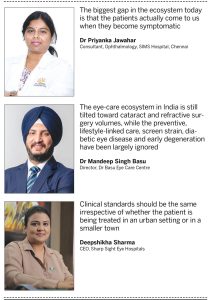
Dr Mandeep Singh Basu, Director, Dr Basu Eye Care Centre, sees several areas gaining attention as the disease profile changes. “Cataract will remain the volume drive of the eye, which comes with ageing, as it is a disorder, but I expect the fastest growth in a few adjacent areas: diabetic retinopathy and medical retina, given India’s diabetes burden; glaucoma management, as awareness and screening improve; paediatric eye care and myopia control, driven by rising screen time in children; and dry eye and ocular surface disease, which has exploded post-pandemic due to digital device use.”
The significance of these segments extends beyond market size. They also create a stronger case for preventive screening, regular follow-up and patient education.
Technology moves from the operating room to the care pathway
Technology has become one of the defining features of the new eye-care market.
The changes are visible in diagnostics, imaging, surgical systems, medical records, teleophthalmology and increasingly in AI-assisted screening. But the impact is not simply about adding sophisticated equipment to hospitals.
Dr Mehta says technology is already changing the patient experience. “New technologies, tools and workflows are making many eye procedures less invasive and more precise. They can also support faster recovery and better patient experiences. As awareness increases, patients are becoming more comfortable with new treatment options and are placing greater trust in technology-led eye care.”
The economics of technology are equally important. If diagnostic tools can identify disease earlier, they can potentially reduce the number of patients who reach hospitals only after significant deterioration. If tele-ophthalmology can connect specialists to peripheral centres, it can also reduce the need for patients to travel for every consultation.
Dr Jain summarises the broader impact succinctly. “Technology is changing both the cost curve and the care pathway.”
This makes technology relevant not just to clinical teams but also to hospital operators and investors. The question increasingly is how technology can improve utilisation, reduce delays and extend specialist capacity.
Dr Sanduja describes how this is happening across multiple stages of care. “Better diagnostics, including OCT, widefield imaging and improved biometry, are helping clinicians detect disease earlier and make more informed treatment decisions.”
The increasing use of digital systems could also support more distributed models of care. A patient can undergo initial screening locally, have images reviewed remotely and be referred to a specialist when required.
AI and the accessibility question
Artificial intelligence is adding another layer to this transition, particularly in retinal imaging and screening.
For a country with a large disease burden and uneven distribution of ophthalmologists, AI-assisted screening could help increase the number of people assessed without requiring a specialist to examine every patient at the first stage.
Dr Chaudhry sees this as one of the more significant technology-led changes. “Digital tools and AI-based screening are perhaps the most exciting shift for accessibility, since they allow non-specialists at a primary level to screen large populations and flag only genuine cases for specialist referral.”
This model could be particularly relevant to diabeteslinked eye disease, where large populations need regular screening.
Deepshikha Sharma, CEO, Sharp Sight Eye Hospitals, points to the speed at which AI can support image assessment. “Technology is allowing us to be more efficient. Through the use of AI, retinal scans can be analysed within seconds and any indications of diabetic retinopathy, glaucoma or macular disease may be pointed out.”
The technology, however, does not eliminate the need for ophthalmologists. Instead, it changes where specialist time is spent. Screening and triage can potentially become more efficient, allowing specialists to focus on diagnosis, treatment and complex cases.
That distinction will be important as providers assess technology investments. Equipment and software have value when they solve a defined clinical or operational problem. Technology on its own is not a substitute for trained manpower or clinical judgement.
Quality has to scale with the network
As organised providers expand, one of the industry’s biggest challenges will be ensuring that growth does not create variation in clinical outcomes.
A multi-centre network can offer wider access, but every additional centre also creates another point at which standards have to be maintained.
Dr Borah stresses the need to build quality into the operating model itself. “The key to maintaining quality as eyecare networks expand is to build consistency into the system from the outset.”
That consistency has several components: standardised clinical pathways, appropriate protocols, outcome measurement, infection control, equipment maintenance and continuing training.
Dr Jawahar brings the workforce dimension into the discussion. “The advances in surgical technology have actually helped us to give that precision and sometimes we can actually use it as a screening tool where we are not available, as in the previous question about the Tier 2 and Tier 3 cities where we are not possible.”
Technology can extend the reach of a specialist, but it cannot fully replace specialist expertise. As networks grow, therefore, training and referral systems become increasingly important.
Sharma makes the principle of consistency explicit. “Growth can never come at the cost of clinical standards. Clinical standards should be the same irrespective of whether the patient is being treated in an urban setting or in a smaller town.”
For hospitals, that means expansion has to be accompanied by investment in people and processes. It also means building mechanisms that allow complex cases to move to centres with the appropriate subspecialty expertise rather than expecting every facility to provide every service.
The workforce challenge
Specialist manpower is already one of the constraints affecting expansion beyond major cities.
Training ophthalmologists takes years, while developing allied clinical teams requires sustained investment. Technicians, optometrists, nurses and other support staff are equally important to the functioning of modern eye-care centres.
Dr Sanduja argues that networks need to build this capacity alongside physical expansion. “The most important principle is that clinical quality must be built into the system, rather than depend entirely on the expertise of individual doctors. As networks expand, standardised clinical pathways, appropriate surgical protocols, infection-control practices and regular outcome audits become essential.”
This also changes the role of larger organised providers. Beyond building centres, they have an opportunity to develop fellowships, continuing education and career pathways that can support specialist retention.
Dr Mehta points to the need to build a stronger talent pipeline. “The key will be trust, transparency and consistency. Standardised processes and strong clinical training will be important as networks grow. We also need to encourage more young people to consider careers in ophthalmology and allied healthcare.”
The requirement is particularly acute outside the metros. A network can centralise certain functions, but local clinical teams still need enough expertise to provide safe and reliable care.
Corneal transplantation and the eye-bank ecosystem
While market expansion often focuses on procedures, hospitals and investment, another important part of the eye-care ecosystem is the availability of donor tissue.
India continues to face a gap between the number of people who could benefit from corneal transplantation and the availability of suitable donated corneas. Improving the system requires action across awareness, registration, retrieval, preservation, allocation and surgical capability.
Dr Mohanta highlights the need for greater coordination. “India needs greater public awareness around eye donation, stronger donor-registration and retrieval systems, better coordination among hospitals and eye banks, and wider access to corneal-transplant expertise and technology.”
The challenge is therefore not restricted to increasing the number of donations. The ecosystem has to ensure that donated tissue can move efficiently through the system and reach patients who need it.
Dr Basu also stresses the importance of building a consistent care pathway. “As eyecare networks expand, consistency must be driven by protocols that are standard and integrative – combining Ayurvedic care like Netra Tarpana and lifestyle-based prevention with modern diagnostics and surgery, so that every centre follows one evidence-based pathway and not a diluted version.”
For the wider sector, the eye-bank system represents an area where hospitals, publichealth institutions, specialists and other stakeholders can work together to address an access gap that cannot be solved by hospital expansion alone.
Dr Mohanta adds that the ecosystem needs to connect donated tissue with patients more efficiently. “A more integrated ecosystem can help bridge the gap between donated tissue and patients in need.”
From treatment to prevention
The next phase of India’s eyecare market will also depend on whether the system can move further upstream.
Today, many patients continue to seek care only after symptoms appear. That can be particularly problematic for conditions such as glaucoma and diabetic retinopathy, where early disease may be difficult for patients to recognise themselves.
Dr Jawahar identifies this as a major weakness. “The biggest gap in the ecosystem today is that the patients actually come to us when they become symptomatic.”
This places greater emphasis on screening programmes, primary-level awareness and referral systems. It also creates an opportunity for hospitals and technology companies to develop models that bring eye-health assessment closer to communities.
Dr Basu points to a similar gap in the current structure of care. “The eye-care ecosystem in India is still tilted toward cataract and refractive surgery volumes, while the preventive, lifestyle-linked care, screen strain, diabetic eye disease and early degeneration have been largely ignored.”
The opportunity is to build prevention and early diagnosis into the routine eye-care pathway rather than treating them as separate initiatives.
That could mean stronger diabetes screening partnerships, school-based vision programmes, community screening, workplace eye-health initiatives and technology-enabled referrals.
Building a connected ecosystem
The industry therefore faces a challenge that is larger than expansion. The opportunity lies in connecting different parts of the system so that patients can move from screening to diagnosis, treatment and follow-up without unnecessary gaps.
Srikanth sees this as an integrated care opportunity. “The strongest opportunity is therefore to build integrated eye-care ecosystems that combine community screening, diagnostics, specialist consultation, surgery and long-term follow-up.”
This model also offers a potential answer to the Tier 2 and Tier 3 challenge. Instead of expecting smaller centres to replicate every capability available in a metropolitan tertiary hospital, networks can connect local facilities to specialist hubs.
Sharma similarly underlines the importance of the support system around smaller centres. “At Sharp Sight Eye Hospitals, our experience has reinforced that expanding access is not just about opening centres, but about building the right clinical support systems around Tier 2 and Tier 3 cities.”
The same principle applies to technology. Digital records, remote consultation and image-based screening can help connect smaller facilities to specialist teams, but they need to be integrated into a functioning clinical pathway.
The role of partnerships will become increasingly important here. Hospitals, technology providers, eye banks, public-health organisations, insurers and financing companies can each address different parts of the access challenge.
The investment opportunity
For investors and hospital operators, the changing market presents several areas of opportunity. These include organised networks, diagnosticled centres, day-care surgery, retina and glaucoma services, refractive care, paediatric ophthalmology and technology-enabled screening.
But the investment case cannot be based only on the number of centres that can be added.
Dr Chaudhry identifies the importance of building capacity where the disease burden is concentrated. “For hospitals and investors, I see genuine opportunity in building scalable, tech-enabled screening networks that feed into specialist centres, in expanding insurance and financing products for chronic eye care, and in training the next generation of ophthalmologists specifically for underserved geographies rather than only urban practice.”
That approach would broaden the market beyond traditional hospital expansion. It would also address some of the structural barriers that have limited access to specialised eye care.
For organised providers, affordability will remain a critical consideration. Advanced diagnostics and procedures can improve outcomes, but their value will be limited if large sections of the population cannot access them.
The next phase of eye care
India’s eye-care market is entering a phase in which scale, technology and specialisation will increasingly converge.
Cataract will remain central to the sector, but it will sit alongside a growing portfolio of retinal, glaucoma, corneal, paediatric and refractive services. Chronic eye diseases will bring patients into longer care pathways, while screening and early diagnosis could become more important in preventing avoidable vision loss.
The expansion opportunity is significant, but the industry’s ability to capture it will depend on how effectively it addresses access, workforce, affordability and quality.
Dr Jain captures the operational challenge succinctly. “Scale without a clinical operating system is just like adding more buildings. Consistency is the hard part.”
That consistency will matter even more as providers move beyond the largest cities. A successful network will need to make its clinical standards portable across locations while allowing care to remain responsive to local needs.
For patients, the real measure of expansion will ultimately be whether specialised care becomes available earlier, closer to home and at a cost they can afford.
Dr Mohanta points to the broader opportunity in strengthening the system around patients. “The key gaps remain access, affordability, awareness, early diagnosis and availability of specialised care, particularly beyond major cities. The opportunity lies in strengthening healthcare infrastructure, expanding technology-enabled care, building clinical capabilities and creating stronger partnerships between hospitals, technology providers and other healthcare stakeholders.”
Way forward
The direction of travel is clear. The next chapter of Indian eye care is unlikely to be defined by cataract volumes alone. It will be shaped by how effectively the sector builds a wider, more connected and more accessible ecosystem around the changing needs of the country’s population.
For hospitals, investors and technology companies, that creates room for growth. For the healthcare system, it creates a larger responsibility: ensuring that growth in capacity translates into timely diagnosis, appropriate treatment and consistent outcomes across geographies.
The opportunity, ultimately, is not simply to build more eyecare centres. It is to build a system in which a patient, wherever they enter it, can reach the right care at the right time.
[email protected]
[email protected]
- Advertisement -
