

Family isn’t an option, it’s a necessity

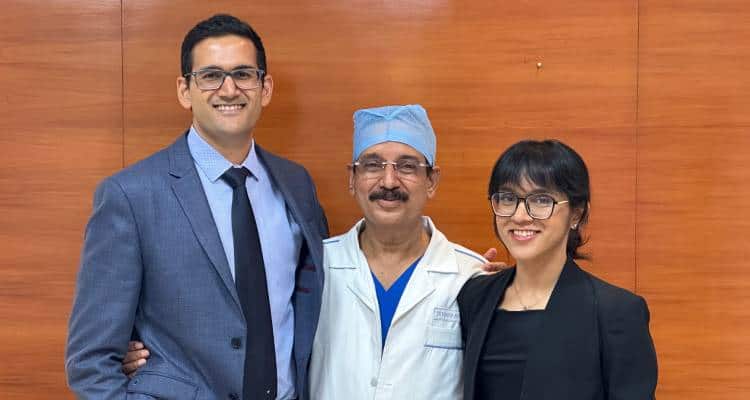

Dr Ramakanta Panda, renowned heart surgeon and Chairman of Asian Heart Institute, Mumbai, built it into one of India’s most respected cardiac care institutions. As the hospital enters its next phase, his children, Saswat Panda and Sonal Panda, are stepping into leadership roles. This Father’s Day, Dr Ramakanta Panda speaks with Kalyani Sharma about the values he instilled in his children while they were growing up, and how he balanced building a hospital with being a father. Sonal Panda, President of Asian Heart Institute, reflects on the leadership lessons she absorbed from him and the legacy she hopes to carry forward.
Dr Ramakanta Panda
You have built the Asian Heart Institute into one of India’s most respected cardiac care institutions. But as a father, how does it feel to now see the next generation stepping into leadership roles within the organisation?
I’m happy, and very proud, because both my children are exceptionally talented, and much of what they’ve achieved, they’ve achieved on their own. They didn’t grow up in their father’s shadow.
I’m proud that they built their own paths, and that they then chose, on their own, to step in and take Asian Heart forward. Healthcare is changing fast, and you need a new generation of entrepreneurs and owners to take an organisation to the next level in step with the times, especially with technology and AI. Both of them are very well suited to that role; their qualifications make them eminently suitable for it.
Looking back, what were the most important values you consciously tried to instill in your children, not as future leaders, but as individuals?
I’ve always been particular about instilling a strong value system in my children, starting with the value of money. Just because we had money didn’t mean we let them grow up without understanding its worth.
As children, if they asked for something, we’d show them what our driver earned, what our maid earned, and compare that to what they were asking for, translating it into months of that person’s salary. I’d also remind them that the person had children of their own. What would happen to those children if something happened to their parent? That’s the kind of perspective we built into them around money. They are extremely conscious of it even today, perhaps ten times more than I am.
The second value system was around ethics: honesty and integrity, instilled from a very young age. They’ve grown up with integrity that matters deeply to them, just as it does to me. You’d never guess how much time they’ve spent abroad. My son went to the US at sixteen and has lived there for over twenty years, yet he speaks in an Indian accent when he’s home and switches to an American one once he’s back in the US.
They still travel economy class, even now. They don’t believe that earning more money means spending more on themselves; the only time they fly business is with me. Even when I try to buy them a business class ticket for their own trips, they won’t accept it.
Those are the fundamentals I built in: humility, honesty, integrity, and a sense of staying rooted to the ground.
My daughter didn’t own a mobile phone through high school or her first two years of college; she only got one once she joined engineering college, without us ever having to insist on it. The same values are visible in my grandchildren today, who are just four: no sweets, no screen time, no iPad. They read books instead. My children have passed that on entirely on their own.
Alongside that, I instilled the importance of giving back to society, and both my children are deeply committed to it. My daughter, for instance, is one of the key motivators behind our work at the Asian Wildlife Trust. Even with a packed schedule, I’ve always made it a point to set aside time for that.
Healthcare is a demanding profession that often leaves little room for personal time. How did you balance the responsibilities of building a hospital with being a father?
I learned this from my own parents: you have to be responsible towards everything, and apportion your time depending on the stage of life you’re in. There’s your career, your family and your society, and each needs its share. At certain points your career has to come first; without it, you’ll never build the financial security to provide for your family.
When I started my practice, I worked Monday to Saturday and my children barely saw me through the week. But unlike most surgeons, who also operated on Sundays, I was firm about one thing: no matter how busy I was, Saturday was a half day and Sunday was always free.
I was operating mainly at Jaslok Hospital and Breach Candy Hospital, while we lived in Bandra. There was a school bus, which we paid for both ways, but I drove my children to school myself every morning, even if it meant leaving early before my own surgery. That gave me about half an hour with them on the road each day; they only used the bus on the way back.
I also never travelled out of the city to operate, unlike many of my peers. The exception was teaching, helping set up cardiac surgery centres in cities that barely had any at the time, work I never took money for. I’d take my children along on those trips too; we’d get the centre running and spend a day together somewhere.
Twice a year, without fail, I took time off entirely for them: fifteen days in May, fifteen in December, no matter how busy I was. Once the hospital was established, that came down to seven days, but it never stopped. Sundays were always theirs. That’s how I built time for both my career and my children.
Every founder hopes their institution and legacy will outlive them. What gives you confidence that the next generation will preserve the core values on which the Asian Heart Institute was built, while taking it in new directions?
The value system built into Asian Heart and the one I imparted to my children are the same. Asian Heart is built on honesty, integrity and ethical practice. We’re one of very few hospitals in the country where, despite treating more than half a million patients, not one of them can say we treated them unnecessarily to make money.
An audit we ran last year found that around 28 per cent of patients we put on medical management had been told elsewhere that they needed angioplasty or surgery, in some cases warned they could drop dead any time without it. Those patients came to us devastated, convinced they were going to die, when nothing beyond medical management and lifestyle change was needed.
We also ran an awareness campaign more than ten years ago about cut practice, which is rampant in healthcare; we’ve never engaged in it. And we never overcharge patients, including the poorest ones. We audit our billing regularly, and on the rare occasions our systems have erred and overcharged someone, even by twenty rupees, we’ve traced it, sometimes six months later, and refunded every patient.
That’s the ethical foundation we’ve built, and my children carry the same value system. I’m confident they’ll take the institution in new directions, because the world is changing, and if you don’t change with it, you become a fossil. We’re at a major paradigm shift in human history; the scale of change AI is bringing to healthcare hasn’t been matched since the Industrial Revolution.
Both of them are well equipped, in knowledge and training, to lead that change while holding on to the ethics and integrity the organisation was built on. We could double our earnings overnight by cutting corners, but we never have, and I’m glad my children feel the same way.
As Asian Heart enters its next phase of growth, how are responsibilities being divided between your children, and how do their backgrounds in healthcare, technology and finance complement the institution’s future?
Both have their own specialisations. My son did his MBA at Harvard and leans towards technology; my daughter did hers at Wharton, specialising in healthcare and finance, and went on to work in the healthcare startup space as the equivalent of chief operating officer at a company heavily invested in AI and healthcare.
So she brings finance and operations, and he brings technology. In 2017, he was named to the Forbes USA 30 Under 30 list of tech entrepreneurs, a recognition very few Indians receive. With healthcare set to become increasingly tech-driven, their skills complement each other without overlapping. He already manages technology, AI and automation; she manages operations and finance.
Your children bring experience from global institutions. What have you learned from them that has influenced your own thinking about the future of healthcare?
Mostly, the importance of automating processes and systems, improving the quality of healthcare delivery, and using technology to bring costs down. I’ve learned a lot from them on that front.
On Father’s Day, when you reflect on your journey as a surgeon, founder and father, what achievement gives you the greatest sense of pride?
More than the hospital, my biggest achievement is my children. They have the right value system, and they got into some of the best universities in the world, Harvard and Wharton among them, without any guidance from me beyond paying their tuition fees. They’re independent and particular about earning their own achievements.
At the same time, they’ve held on to their values. A lot of people who move to the US end up changing who they are; my children adopted Western values while staying deeply rooted in Indian ones. They’ve taken the best of both, and that, as a father, is what I’m proudest of.
The hospital comes second, my professional achievements third. They’re well-rounded, balanced individuals with excellent values, probably in the top 0.1 per cent of students who make it into the best universities in the world, almost entirely on their own. Tuition fees were the only thing I contributed.
What message would you like to give to all the fathers in this profession, the doctors?
Don’t let your profession consume your life. Get a balanced life. No matter how busy or ambitious you are, keep something for your family, and don’t let your passion for your profession take over everything else.
I always say you should keep four things in balance: your profession, your family, yourself and your society. It’s important to keep space for yourself. I’ve tried to live by that, though naturally some periods tilt more towards one area. When I started my practice in Mumbai in 1993, my career took priority, and the other three areas took something of a back seat, though none of them disappeared. I still made time for family, for myself, and for charity work, which I never stopped.
When I set up my next hospital, the same thing happened, but I made sure to balance it with time for family and myself. I often give this example: I did my MBBS at a government medical college for fifteen rupees a month in tuition, while today parents spend two to three crore rupees on their children’s education. That difference didn’t come from me; it came from society, and I feel I owe something back for the free education I received.
At this stage of life, my children remain my top priority, followed by my profession, and increasingly my responsibility towards society. That’s why I run two trusts and spend five to six days a month in the forest, not just for photography, but because the trust does real work in cultural education, with forest workers helping out, as well as building schools in tribal areas for development and education. My children are taking over the hospital now, so my role there has shifted from daily management to broader direction. My priorities today are my children, my responsibility to society, and my grandchildren.
My advice to every father in this profession: don’t let your passion for your work consume your life. Keep time for your family, time for yourself, and make sure some part of your life goes towards giving back to society.
Sonal Panda
Your father built the Asian Heart Institute from the ground up and became one of the world’s most respected cardiac surgeons. What are some of the leadership lessons you absorbed simply by watching him over the years?
Excellence is a daily discipline, not a one-off event. Growing up, we watched him return home tired but always mentally alert. He’s always consistent in the small habits ; whether it’s attention to detail and perfectionism in everything he did from photography, to interior design to even bathroom remodeling. He always expected high standards from himself before expecting it from others (and we were of course kept to high standards at school!). He never sat on his reputation; rather he kept working hard to continue earning it.
During your own health challenges, your father remained deeply involved in helping you find answers when many experts had exhausted their options. How did that experience shape your understanding of him not just as a doctor, but as a father?
Family isn’t an option, it’s a necessity. Despite his busy schedule, he would align his work timings to often drop us off at school and see us before bedtime. Similarly, ethics and outcomes aren’t separable. Patients and families have always trusted him with their lives and he never takes it lightly. Growing up, we always saw him give people honest advice (stop smoking, eat healthy, exercise, don’t opt for surgery unless absolutely necessary.) And of course his professional ethics flowed into our personal life as well; whether it came to schoolwork or how we dealt with challenges. One thing I’ve always been inspired by is that he never gives up. And through my illness, the fact that he never gave up on me, made me resilient too. The other thing is that he can separate excellence from mediocrity effortlessly. We were able to reach out to the world’s best doctors to understand and treat my condition.
As you help lead Asian Heart Institute into its next phase, what aspects of your father’s legacy do you feel most responsible for carrying forward, and where do you hope to add your own imprint?
There are many. But if I had to pick a few, it would be the ability to dive deep while thinking broad. This is a rare combination. He also combines the precision of a surgeon with the systems thinking of an institution-builder. He can think deeply about a patient, a surgery, a process and also think broadly about how to build a hospital that can deliver excellence consistently. His success as a surgeon from very humble beginnings has taught me that it’s possible to dream and achieve ethics and integrity along with success. Today healthcare is becoming financial and transactional but my father built AHI around a basic principle: the patient comes first. Hoping to continue nurturing the systems that enable it over short-term goals. In AHI’s culture, quality isn’t negotiable. We’ve built a strong talent, discipline, systems-based pipeline. So need to continue attracting and nurturing the best clinical talent, create strong pipeline for next generation. While my brother Saswat and I will strive to continue his legacy, what I hope to impact personally are the following areas:
A. Technology: Radically improve patient experience and outcomes through the latest in what’s available in technology, while also leveraging tech to ensure ethics systems are being monitored and maintained.
B. Preventive health: Healthcare needs to move earlier down the chain to prevent negative behaviors and augment positive ones. My father has always supported this through his work and his first-line of advice to his patients. The utlimate outcome isn’t successful surgery but helping people avoid reaching that stage.
- Advertisement -
