

Health Parliament and Brooke India submit draft planetary health policy framework to Government of India
It offers a unifying operational layer - one that aligns ministries, strengthens surveillance interoperability, links environmental signals to health action, and integrates animal and human health intelligence into governance

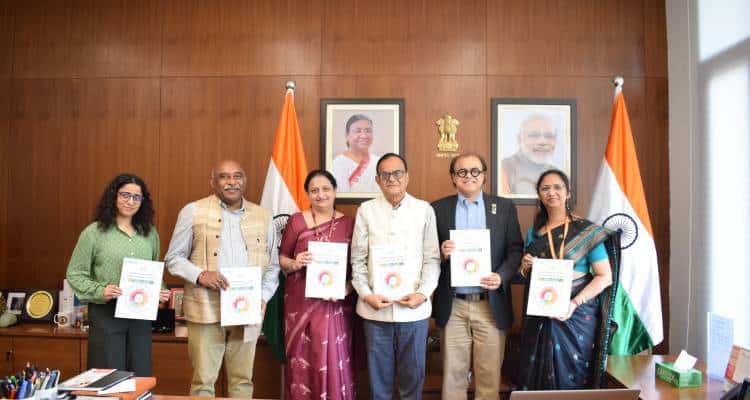

In a significant milestone for public health governance in India, the Draft Planetary Health Policy Framework for India was formally presented to Dr Ajay Kumar Sood, Principal Scientific Adviser (PSA) to the Government of India, by Dr Rajendra Pratap Gupta, Founder and Chairman of Health Parliament and Former Advisor to the Union Health Minister, Government of India; Brig J.S. Dharamadheeran, CEO, Brooke India; and Dr Manpreet Kaur, Associate Project Director, Health Parliament in the presence of Dr (Mrs.) Parvinder Maini, Scientific Secretary, Office of the PSA to the Government of India; Dr Sangeeta Agarwal, Scientist ‘F’, Office of the PSA to the Government of India; Dr Sindura Ganapathi, Visiting PSA Fellow . The framework, developed over a year-long consultative process involving more than thirty leading experts from across human health, veterinary science, environmental management, and public policy, represents India’s most comprehensive One Health governance blueprint to date.
A framework born of urgency
The COVID-19 pandemic, alongside repeated outbreaks of Nipah virus, avian influenza, has laid bare the structural fragility of India’s siloed approach to health. With over 75 per cent of emerging infectious diseases originating from animals, and 80 percent of agricultural communities dependent on livestock for their livelihoods, the health of humans, animals, and the environment are deeply intertwined yet India’s institutional responses have historically treated them in isolation. The cost of this fragmentation, epidemiological, economic, and social, is rising.
The Draft Planetary Health Policy Framework directly addresses this gap. It offers a unifying operational layer – one that aligns ministries, strengthens surveillance interoperability, links environmental signals to health action, and integrates animal and human health intelligence into governance. In the words of Dr Gupta, the framework seeks to move One Health “from a collaborative slogan to a governing instrument.” In the foreword to the framework, Dr Gupta also emphasised that it is now time to move beyond siloed interpretations of One Health and adopt a broader planetary health perspective.
Twelve pillars of planetary health
The framework is structured around twelve policy thrust areas including Integrated Institutional Framework; Awareness and Community Outreach; Data, Surveillance, and Early Warning Systems; Capacity Building and Workforce Development; Research and Innovation focused on indigenous diagnostics and vaccine development.
The framework dedicates particular attention to Antimicrobial Resistance (AMR) Containment, calling for robust stewardship programmes across human and veterinary healthcare settings and phasing out antibiotics as agricultural growth promoters.
Further pillars cover Sustainable Consumption and Development; Emergency Preparedness and Zoonotic Outbreak Response; Financing and Incentives; Technology and Entrepreneurship; Trade; and Public-Private Partnership, recognising that the scale of the challenge exceeds what any government can address alone.
Dr Gupta shares, “We stand at a pivotal moment in history, facing a crossroads that will determine the future of our civilization. The well-being of our people is intricately linked to the health of our planet, its inhabitants, its ecosystems, and its climate. The concept of One Health is not merely an idea; it is an absolute necessity. The release of India’s Draft Planetary Health Policy Framework serves as a clarion call to the global community, emphasising a fundamental truth: sustainable development, universal health coverage, and climate commitments cannot be pursued in isolation. I implore policymakers, health leaders, scientists, civil society, and international partners to engage with this framework not as a mere document, but as a declaration of shared responsibility.”
Brig. J.S. Dharamadheeran, CEO, Brooke India mentions, “The “Planetary Health Policy framework” formulated by the Health Parliament in partnership with Brooke India and submitted to the Government of India, marks a new milestone in the Indian initiative of engendering Viksit Bharat’s initiatives in this domain as an inherent part of “Vasudhaiva Kutumbakam”.
Vision for 2047
The framework sets out a phased roadmap from establishing multi-sectoral coordination mechanisms, to integrating real-time digital surveillance platforms, to positioning India as a global hub for One Health research and innovation by 2047. The Vision for 2047 envisions zero preventable deaths from zoonotic diseases such as rabies, AI-driven predictive systems that detect outbreak risks before they reach human populations, healthy and biodiverse ecosystems, and empowered communities acting as first responders to health threats in their regions.
The document draws on the ancient Indian principle of Vasudhaiva Kutumbakam – the world is one family – as the philosophical foundation for a health security architecture that recognizes all life forms and the Earth that sustains them as part of a single interconnected system.
- Advertisement -