

The missing links in animal health
As India strengthens its healthcare ecosystem, animal healthcare infrastructure is emerging as one of its most important and most overlooked, foundations


Not too long ago, a virus that most likely jumped from animals to humans brought the whole world to its knees. The COVID-19 pandemic shut down factories, grounded flights, emptied cities and cost economies trillions of dollars. It delivered a powerful lesson that animal health and human health cannot be seen in isolation. They are two sides of the same coin.
Yet, animal health remains one of the least discussed, and most underestimated determinants of India’s economy despite its huge implications for some of the country’s biggest growth industries, i.e. dairy, poultry, livestock. A single disease outbreak can erase years of progress, cripple production, disrupt exports, slash yields and wipe out incomes within weeks. The economic damage extends far beyond the farm, affecting processors, pharma companies, vaccine manufacturers, exporters, retailers and ultimately, consumers. Meanwhile, the country’s rapidly growing companion animal sector is also increasing demand for better veterinary services, diagnostics and preventive healthcare.
For India, therefore, investing in animal health is no longer a welfare decision. It is an economic strategy that protects productivity, safeguards supply chains, preserves export competitiveness and strengthens national food security.
But intent alone won’t cut it, we need an ecosystem that is robust. And, veterinary hospitals, diagnostic laboratories, disease surveillance networks, vaccine manufacturing facilities, cold chains, digital monitoring systems and a skilled veterinary workforce are the foundation of that ecosystem.
So, how prepared is India’s animal health infrastructure?
Taking the pulse
According to a 2024 report by Action for Animal Health, India has over 13,000 veterinary hospitals, nearly 23,000 veterinary dispensaries and more than 33,000 veterinary aid centres. The ecosystem is supported by a network of central, regional and state disease diagnostic laboratories, animal quarantine stations and the Chaudhary Charan Singh National Institute of Animal Health, the nodal institute for veterinary vaccine licensing. To improve last-mile access, the government is also supporting the rollout of Mobile Veterinary Units, with the ambitious goal of one unit for every one lakh livestock.
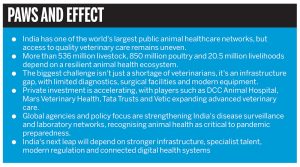
On paper, this is one of the world’s largest publicly funded animal healthcare networks. Yet access to quality veterinary care remains uneven. The challenge is clear when viewed against the scale it is expected to serve. India is home to 536 million livestock and around 850 million poultry, while more than 20.5 million people depend on livestock for their livelihoods. So, an ecosystem of this size cannot afford weak links. Every delayed diagnosis, missed vaccination or disease outbreak carries significant economic consequences.
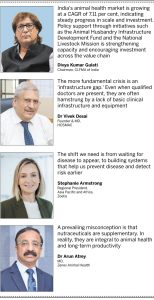
Even so, there are signs of steady progress. “India’s animal health market is growing at a CAGR of 7.11 per cent, indicating steady progress in scale and investment. Policy support through initiatives such as the Animal Husbandry Infrastructure Development Fund and the National Livestock Mission is strengthening capacity and encouraging investment across the value chain,” says Divya Kumar Gulati, Chairman, CLFMA of India. He adds that India has made notable progress in expanding disease surveillance, strengthening vaccine manufacturing and embracing digital technologies.
At the same time, the private sector has been steadily expanding its footprint through veterinary clinics, diagnostic laboratories, NGOs and technology-enabled herd health management services. The trend is visible across both livestock and companion animal healthcare.
 To cite a few examples:
DCC Animal Hospital, backed by South Korea’s A’alda, entered the Indian market in 2019, followed by the launch of its flagship multi-speciality hospital in Gurugram in 2021. Today, it has six centres spread across Delhi, Haryana and Rajasthan.
In December 2024, Mars Veterinary Health acquired a minority stake in Crown Vet, marking one of the first major investments by a global veterinary healthcare company in India’s veterinary services market.
Tata Trusts Small Animal Hospital in Mumbai opened in 2024 for advanced companion animal care with speciality services, modern diagnostics and clinical infrastructure.
Vetic, a pet healthcare organisation with a network of 40 pet hospitals and clinics across 11 cities, announced its expansion plans in Jan 2025, with seven 24/7 multi-speciality hospitals equipped with advanced diagnostics, intensive care units and surgical facilities.
The elephant in the barn
Yet, these advances coexist with deep gaps. Large parts of the country lack adequate veterinary infrastructure, and face challenges of limited diagnostic capacity, workforce shortages and uneven access to quality care. As India’s livestock economy expands and its companion animal market matures, these gaps become more than healthcare challenges.
The shortage of veterinarians is one of the most visible challenges. India has roughly one veterinarian for every 5,000 animals, against a recommended ratio of one per 500.
But according to Dr Vivek Desai, Founder & MD, HOSMAC, the shortage of vets isn’t even the real story. “The more fundamental crisis is an ‘infrastructure gap.’ Even when qualified doctors are present, they are often hamstrung by a lack of basic clinical infrastructure and equipment,” he says.
Take Uttar Pradesh for instance. Dr Desai points out that more than 40 per cent of government facilities in the state operate without a qualified veterinarian on-site. But even those that are staffed struggle to provide comprehensive care. Only 15 per cent of the state’s veterinary hospitals have working surgical facilities, and less than 10 per cent have functioning diagnostic labs.
As he puts it, “for the vast majority of cases, care is purely symptomatic.” A dairy farmer whose cow falls sick isn’t just dealing with a vet shortage. He is dealing with a system where there may be no way to actually diagnose what’s wrong without an X-ray machine, an ultrasound, or even basic blood work available locally. The consequence is delayed diagnosis, delayed treatment and, often, preventable losses. As Dr Desai explains, “The challenge, therefore, is not just about producing more doctors, but about a substantial ecosystem where they can actually provide lifesaving care.”
The cost of failing to do so is significant. The report by Action for Animal Health notes that animal diseases and zoonoses account for 35 per cent of all trade concerns raised before the World Trade Organization’s (WTO) Sanitary and Phytosanitary Committee. Closer home, news reports estimate that pests and diseases account for nearly 35 per cent of economic losses in India’s livestock sector.
This goes to the heart of India’s animal health challenge. It is about the ecosystem that supports them. Without diagnostics, clinical infrastructure and modern equipment, even the besttrained professionals can do only so much. While metropolitan cities are witnessing investments in advanced veterinary hospitals, rapidly growing Tier II cities continue to lack 24/7 emergency care and advanced diagnostics.
Bridging this infrastructure gap is critical for India to build a resilient healthcare system.
Designed for healing
It’s tempting to think the fix is simple, build more hospitals, clicnics and diagnostic centres, on the same blueprint as human ones. But, Dr Desai says that’s a mistake. “Designing a hospital for animals is fundamentally different from human hospital architecture because it must account for species specific stress, physical handling needs, and extreme biohazard risks,” he explains.
A modern veterinary hospital requires separate waiting areas and wards for cats and dogs, sometimes even pheromone calming systems to minimise stress. It must also cater to vastly different species. “A veterinary facility in a region like Lucknow must accommodate everything from 3 kg cats to 500 kg cattle,” highlights Dr Desai. That means planning for shaded crush yards for livestock, equine surgical theatres with recovery stalls and carefully designed movement from triage to diagnostics to surgery. Design and build not just for convenience, but also to minimise the spread of diseases such as rabies and brucellosis between animals and the humans treating them.
HOSMAC is currently designing two advanced animal hospitals for Shrimad Rajchandra Mission in Dharampur and Mumbai. Conceptualised from the animal’s perspective, the facilities incorporate specialised spatial design, species-appropriate materials, lighting and recovery-focused layouts, informs Dr Desai.
But, the challenge extends well beyond hospital design. According to the Action for Animal Health report, many of the experts it surveyed highlighted poorly equipped public laboratories, limited biosafety practices, particularly at the district level, and an “inadequate dynamic system to get an accurate picture of the disease situation at any time.”
More than bricks and mortar
In other words, the gap is not just infrastructure, but capability. Buildings alone cannot deliver better animal healthcare. It increasingly needs connected systems like modern diagnostics, robust laboratory networks, strong biosafety systems and real-time disease surveillance that can predict, detect and respond to disease outbreaks. Without them, even the best-designed facilities will struggle to deliver timely and effective care.
Stephanie Armstrong, Regional President, Asia Pacific and Africa, Zoetis, believes the focus needs to shift from reacting to disease to building systems that prevent it. “The shift we need is from waiting for disease to appear, to building systems that help us prevent disease and detect risk earlier,” she says.
That requires much more than veterinary hospitals alone. As Armstrong explains, “Science only delivers when the systems around it are strong. That means robust biosecurity, surveillance, rapid diagnostics, transparent reporting and collaboration across government, industry and the veterinary community.”
India has already begun building many of these systems. The Action for Animal Health report traces the evolution of the country’s disease-reporting architecture, from the National Animal Disease Reporting System launched in 2013, to the Information Network for Animal Productivity and Health (INAPH), to the Bharat Pashudhan application under the National Digital Livestock Mission (NDLM), which is meant to eventually replace INAPH altogether.
The ambition is real but the execution remains a work in progress. According to Armstrong, “The real opportunity is to make those systems more connected. If something is detected at farm level, that information should move quickly through veterinary, public health and government systems so that risk can be assessed and action taken earlier.”
There is growing recognition of this reality and it is reflected in the investments flowing into the sector. Funding under the G20 Pandemic Fund to strengthen animal health security, the World Bank’s Animal Health System Support for One Health Program and the Asian Development Bank’s investment in Zenex Animal Health. Collectively, these investments signal that animal health is increasingly being viewed as critical infrastructure.
Policy in India is also evolving to support this transition. To strengthen the veterinary ecosystem, the government has proposed a credit-linked capital subsidy scheme for the establishment of private-sector veterinary and para-veterinary colleges, animal hospitals, diagnostic laboratories and breeding facilities. The initiative aims to increase the number of veterinary professionals to over 20,000, while also facilitating collaborations between Indian and foreign institutions.
Prevention is the best medicine
India has made significant progress in strengthening its animal health ecosystem. The next challenge is making it futureready.
For Dr Desai, that requires action on three fronts, i.e. building specialist talent, creating a more enabling regulatory framework for veterinary medicines and diagnostics, and accelerating digital integration. As he puts it, “The current ‘generalist’ model is failing.”
Likewise, nutrition is emerging as an equally important pillar.
According to Dr Arun Atrey, MD of Zenex Animal Health, “A prevailing misconception is that nutraceuticals are supplementary. In reality, they are integral to animal health and long-term productivity.” For livestock, nutraceuticals “offer a powerful lever to enhance productivity, improve animal health, and enable more predictable earnings” for farmers. In the companion animal segment, they are shifting “from optional choice to essential components of overall pet wellness.”
However, wider adoption will require greater awareness and a stronger regulatory framework. Together, these priorities, skills, regulation, digital integration and preventive nutrition, will shape the next phase of India’s animal health ecosystem.
One health, one future
Animal healthcare is no longer simply about treating sick animals. It is about protecting public health, strengthening food systems, securing livelihoods and building resilience against future disease threats.
Armstrong captures this broader shift wel, “As livestock systems become more complex, the most effective approach will be a connected One Health system: good farm practices, strong veterinary capacity, science-led surveillance and prevention, and close collaboration across industry, government and public health authorities.”
India has already shown what such an approach can achieve. Kerala’s coordinated response to the Nipah virus outbreaks demonstrated how collaboration between animal health, public health and government agencies can contain disease before it escalates. It is a reminder that One Health is not simply a policy aspiration but a practical framework for managing future risks.
The question, then, is no longer whether India should invest in animal healthcare infrastructure. It is whether it can afford not to. As emerging infectious diseases, antimicrobial resistance and climate-related health risks continue to grow, investments in veterinary care, diagnostics, surveillance and preventive healthcare become investments in public health itself. The healthcare systems that succeed in the future will not be those that respond fastest to outbreaks, but those that prevent them.
- Advertisement -
Excellent article highlighting why animal health deserves far more attention in India’s healthcare and economic planning. The emphasis on the One Health approach is particularly important strong veterinary infrastructure, disease surveillance, and preventive care don’t just protect animals; they safeguard public health, food security, and rural livelihoods. A timely and insightful read.